
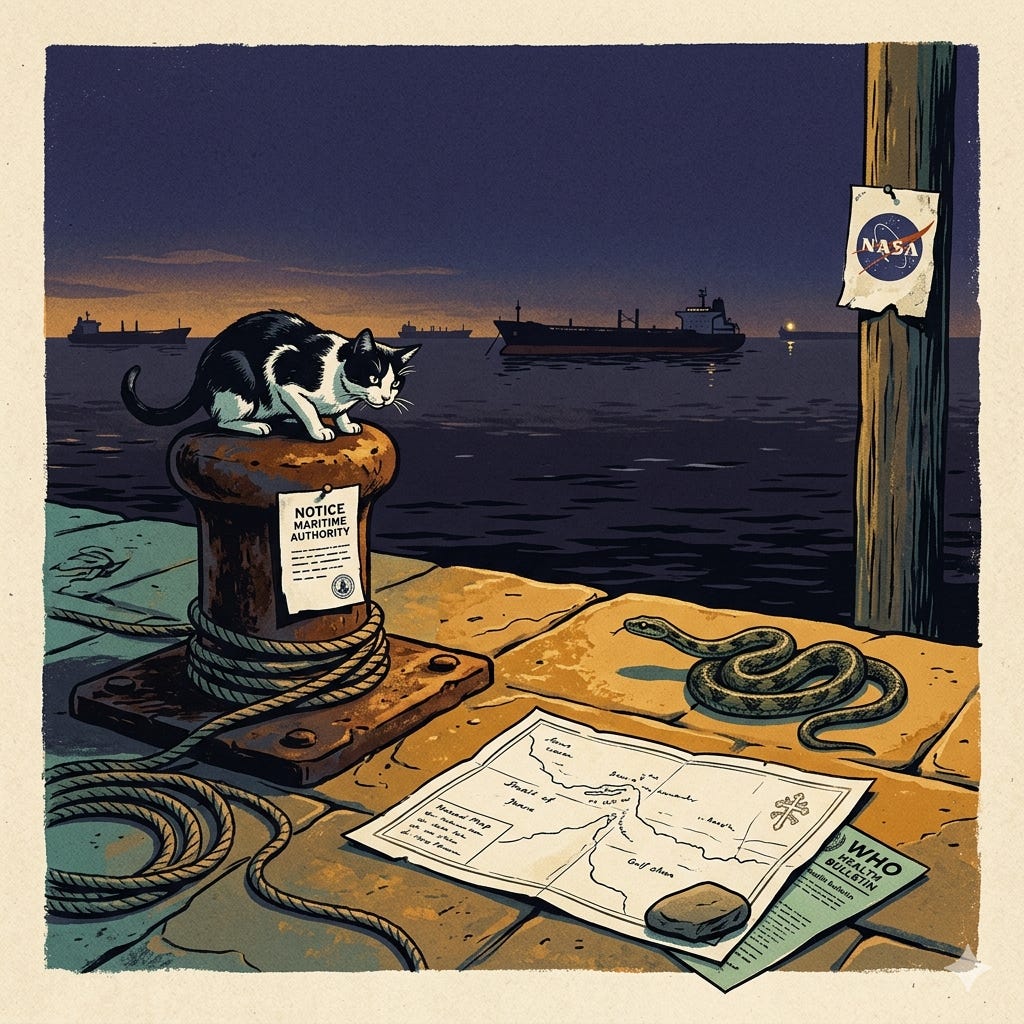
🧭 The Strait Was Open Before This War Started. Trump Is Now Calling Its Reopening a Victory.
🧭 Morning Compass — Monday, May 25, 2026

Your support makes it possible to produce these Morning Compasses:
Receive Morning Compass in your mailbox and support independent journalism:
What’s the news
Yesterday, I wrote that the optimism in much of the mainstream press felt premature. Today, the BBC and The Guardian are catching up. Iran’s foreign ministry says a deal is not imminent. Trump says he has told negotiators not to rush. He said on Saturday that an agreement had been largely negotiated. On Sunday, he said both sides must take their time.
Markets moved on his Saturday statement. Oil prices fell. Then Iran’s foreign ministry spokesman said no one can claim a signing is imminent. That is a pattern worth recognizing. After nearly a full term and a half, it is time to judge Trump on what he does, not on what he says.
Let me be direct about what is actually happening. Eleven weeks ago, Trump declared on social media there would be no deal with Iran “except UNCONDITIONAL SURRENDER.” The deal now emerging — according to reporting from the Guardian, the New York Times, and AP — reportedly offers Iran sanctions relief, up to $20 billion in unfrozen assets, and a 60-day window to negotiate on its nuclear program with no agreed outcome. Missile constraints do not appear to be part of the framework at all. Remember how Iran’s foreign ministry spokesman marked the moment by sharing an image on social media of a Roman emperor bowing to an ancient Persian king? He was not being subtle.
The point being avoided in most coverage is this: the Strait of Hormuz was open before the US and Israel attacked Iran in late February. The Strait’s closure is a direct consequence of that war. A deal that reopens it does not represent a victory. It represents a return to roughly the situation that existed before the conflict began. That is my reading, and I am not alone in it. A former US Mideast negotiator told the New York Times: “Original, unrealizable war aims abandoned, and now little leverage to secure what really matters.”
Gas prices in the US stand at around $4.51 a gallon according to AAA, up about 51 percent since the war began, per the New York Times. And even if a deal is signed this week, the International Energy Agency has estimated it will take a minimum of two to three months to re-establish normal shipping — mines must be cleared, some 1,500 to 2,000 trapped vessels need to move, and insurers must recalculate risk before tankers sail again. The midterm elections in November are not that far away.
This morning, Iran announced it is charging fees for what it calls “navigational services” through the strait, though its foreign ministry insists these are not tolls, Euronews reports. Five Gulf states — Bahrain, Kuwait, Qatar, Saudi Arabia, and the UAE — have already sent a joint letter to the International Maritime Organization warning shipping companies not to comply, according to Euronews. Iran also published a map last week claiming regulatory control over waters that the UAE and Oman consider their own sovereign territory. This is not the behavior of a country preparing to return an international waterway to open passage.
One detail in NPR's reporting stands out. Iran's semi-official Tasnim news agency reported that the strait "will not return to its pre-war status" under any agreement. That is Iran's own media saying, plainly, that the outcome Trump is calling a victory does not restore what existed before. NPR also reports that Israel is, in the words of a person familiar with the matter, "very unhappy with the emerging deal" and views it as an economic arrangement that does not address its security concerns. A senior Israeli official told reporters that the agreement "signals to the Iranians that they possess a weapon no less effective than a nuclear one, and that is the Strait of Hormuz." As of Saturday, around 240 ships were still waiting for Iran's permission to pass through the waterway, according to Iran's IRGC Navy.
Iran is an experienced negotiating partner. The Islamic Republic has spent decades in talks with world powers. It knows how to extract concessions in phases and how to frame any outcome as a domestic victory. And it knows, from its very first year in power, how to use American electoral timing as leverage.
In 1979, Iranian students seized the US embassy in Tehran and took 52 Americans hostage. The new Islamic Republic understood exactly what it was doing politically. The hostages were held for 444 days. They were released on January 20, 1981 — the precise moment Ronald Reagan was inaugurated, not one day before. Whether by design or by extraordinary coincidence, Jimmy Carter never got the credit. Many historians believe the timing cost him the election.
That was forty-five years ago. The people now negotiating for Iran grew up in that tradition. Nuclear talks are reportedly set to begin around June 5 in Pakistan, according to the Guardian, and could last 60 days. Count forward from there, and you reach early August — directly in the final stretch before November’s midterms. A failure to reach a nuclear agreement at that point would land at the worst possible moment for the White House. Trump said at the start of this war that he would get everything he wanted. He is now telling negotiators not to rush.
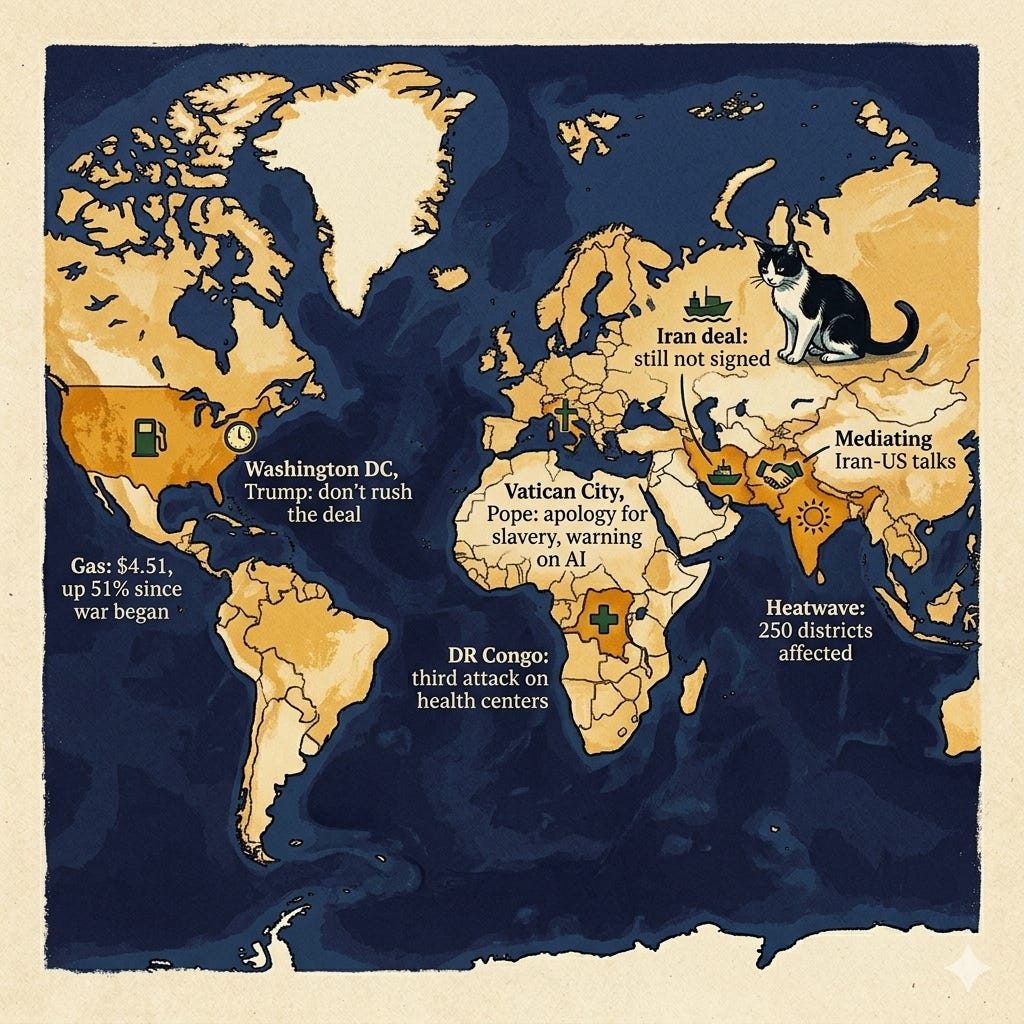
Pope Leo XIV published his first encyclical today, a document of roughly 42,000 words titled “Magnifica Humanitas,” or Magnificent Humanity. It is primarily a moral intervention on artificial intelligence: calls for government regulation of AI companies, protection for workers whose jobs are at risk, safeguards to keep humans responsible for weapons decisions, and protection for children from AI-generated content online. Leo presented the document alongside Christopher Olah, a co-founder of Anthropic, in what the New York Times described as a symbolic gesture of dialogue between spiritual and technological leadership.
He also made what the Vatican and observers described as the first formal papal apology for the Holy See’s own role in legitimizing slavery — specifically the 15th-century papal bulls that gave European sovereigns explicit authority to conquer and enslave non-Christians. Previous popes had apologized for Christians’ participation in the trade. None had addressed the popes’ own institutional role until today.
The Ebola outbreak in eastern Congo is worsening. On Sunday evening, a group of men stormed the Mongbwalu General Hospital treating Ebola patients, demanding the bodies of relatives, AP reports. A day earlier, a Doctors Without Borders treatment tent in the same town was attacked and burned. Eighteen patients fled and remain unaccounted for. The WHO has raised its risk assessment to “very high.” There are more than 900 suspected cases in northeastern Ituri Province, with reported deaths in the triple digits, though regional figures suggest the true toll may be higher. There is no widely deployed approved vaccine for this particular strain, a rare variant called Bundibugyo. Some US programs designed to detect and respond to exactly these outbreaks have been reduced or eliminated under the current administration.
A new study in PLOS Neglected Tropical Diseases, involving WHO researchers, warns that climate change is pushing venomous snakes toward new territories. As temperatures rise, species including African spitting cobras, Asian kraits, and European vipers are projected to expand their ranges toward more densely populated areas by 2050. In India, the most dangerous species are expected to move from the south toward the much more densely populated north. The global estimate stands at around four million snakebites annually. The risk falls hardest on poor rural communities where farmers work without shoes and healthcare is far away.
If you enjoy reading Morning Compass 🧭, please share this article; it helps to reach a wider audience:
What to watch today
Rubio said this morning there might be news on the Iran deal, “maybe today.” Iran’s foreign ministry said a signing is not imminent. Watch whether any announcement emerges before US markets open Tuesday — Memorial Day keeps Wall Street closed today, which reduces some of the immediate pressure on both sides.
The Pope’s encyclical will draw responses from technology companies and governments throughout the day. The EU, which already has AI regulation in place, will be among the first to respond.
On this day
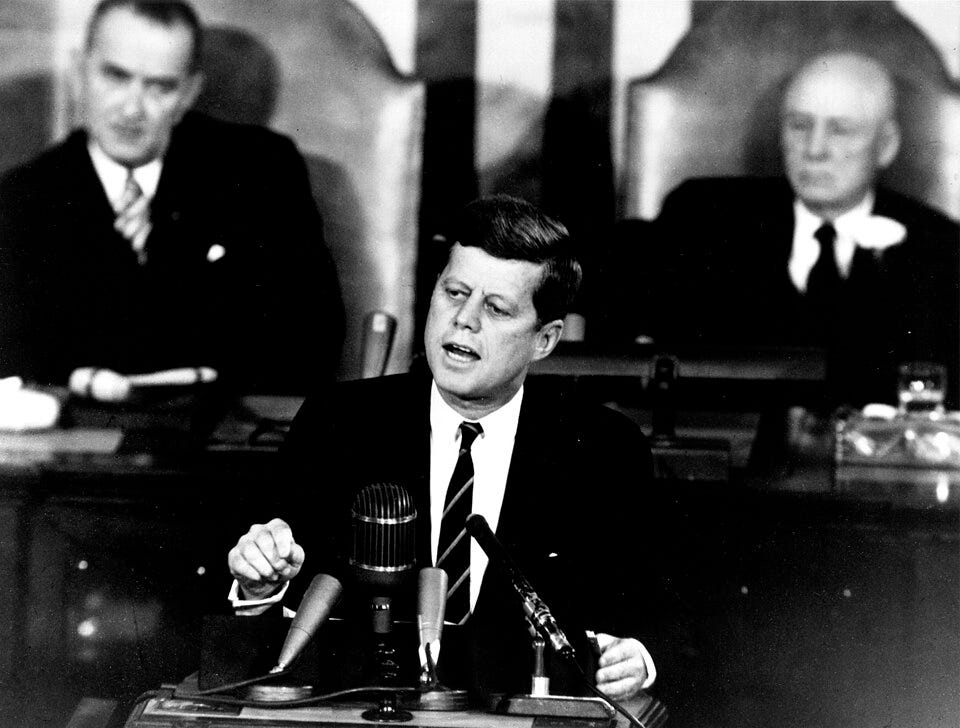
On May 25, 1961, President John F. Kennedy stood before a joint session of Congress and committed the United States to landing a man on the moon before the end of the decade. It was an extraordinary promise. At the time, the US had roughly 15 minutes of total human spaceflight experience. Kennedy set a clear goal, a hard deadline, and defined what success looked like. Eight years later, Americans walked on the moon.
It is worth sitting with that contrast on this Memorial Day morning.
Today is
Memorial Day in the United States is a federal holiday honoring military personnel who have died in service.
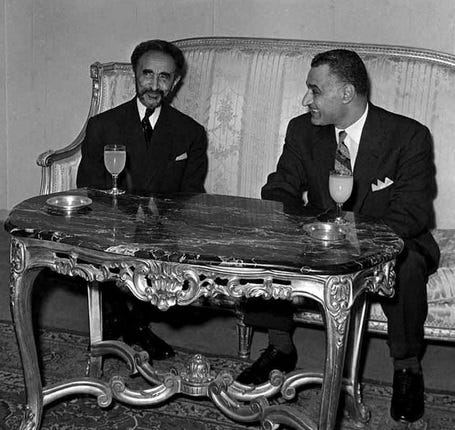
It is also Africa Day, marking the founding of the Organization of African Unity in 1963, now the African Union. Sixty-three years of a continent working, imperfectly and persistently, toward its own collective future.
What I wrote

What I captured

Oslo, where the water is clean enough to kayak through the city centre, and where the fjord has been handed back to its residents. The highway that once cut the city off from the water runs underground now. What replaced it is this: new neighbourhoods in warm brick, kayakers on a still evening, and a waterfront that belongs to people again rather than to cars.
What I’m working on
Daybreak Notes & Beans, Screen Skills, and perhaps another video.
And I would like to know
Trump said he would get everything he wanted from Iran. The deal now emerging gives Iran sanctions relief, unfrozen assets, and 60 days to negotiate on nuclear issues with no guaranteed outcome.
Is this a deal, a delay, or something else entirely?
On More and the Morning Compass
You just read the Morning Compass — a daily read that arrives while you are still on your first coffee, tells you what happened overnight, what to watch today, and gives you something worth talking about. It will be here every morning in May as we try out the format, and it will keep getting sharper.
Morning Compass is one of the productions within the More newsletter. Because More is also where the rest of the story lands. The follow-ups that don’t fit Daybreak Notes & Beans. The deeper dives. The reader questions that deserve a real answer. The personal moments and the European perspective on what Americans are living through. If that layer of the work matters to you, consider becoming a paid subscriber:

Stumbled upon
The cutest video of today: a lost baby lamb is reunited with its mother 🥹
Have you seen the beautiful sight of rose petals falling from the Pantheon’s oculus on Pentecost Sunday? Here you see the backstage masterminds, the Rome firefighters. Would you dare to do this?
Notes and sources
Iran deal — BBC News, ‘Deal with US not imminent, Iran says’ — https://www.bbc.com/news/articles/cglpp2yk336o
Iran deal overview — The Guardian, ‘US and Iran inch closer to peace deal as Trump faces criticism from GOP hawks’ — https://www.theguardian.com/us-news/2026/may/23/donald-trump-revenge-republicans-thomas-massie
Iran deal analysis — New York Times, ‘To Get the Strait Open, Trump Had to Leave the Hardest Issues for Later’ — https://www.nytimes.com/2026/05/24/us/strait-of-hormuz-reopen-iran-deal.html
Iran navigational fees — Euronews, ‘Iran says it is charging fees for navigational services through Strait of Hormuz’ — https://www.euronews.com/2026/05/25/iran-says-it-is-charging-fees-for-navigational-services-through-strait-of-hormuz
Iran deal progress — Euronews, ‘Iran says progress on many issues with US but final peace agreement not imminent’ — https://www.euronews.com/2026/05/25/trump-urges-negotiators-to-not-rush-potential-deal-with-iran-as-new-details-emerge
Iran deal explainer — AP News, ‘What to know about possible Iran war deal’ — https://apnews.com/article/iran-united-states-deal-explainer-war-b1659232611edc10808612e30647c17d
Pope encyclical and slavery apology — AP News, ‘Pope apologizes for Holy See’s role in legitimizing slavery’ — https://apnews.com/article/pope-apologizes-slavery-role-holy-see-vatican-78df993c5604eb098b19f255b89b3155
Pope encyclical on AI — New York Times, ‘Pope Leo Warns of Risks From A.I. in 42,300-Word Encyclical’ — https://www.nytimes.com/2026/05/25/world/europe/pope-leo-encyclical.html
Ebola Congo — AP News, ‘Eastern Congo sees a third attack on health centers treating Ebola’ — https://apnews.com/article/ebola-congo-mongbwalu-funeral-bodies-attack-9c4237e6ed4e26dff22b242749e37e33
Snakes and climate — Euronews, ‘Deadly snakes might be coming to a neighbourhood near you’ — https://www.euronews.com/health/2026/05/25/deadly-snakes-might-be-coming-to-a-neighbourhood-near-you
videos: lamb: yoda4ever on x. Rome: mamboitaliano on x
"Oslo, where the water is clean enough to kayak through the city centre, and where the fjord has been handed back to its residents."
Ah, to have a government where this is valued.
"The cutest video of today: a lost baby lamb is reunited with its mother 🥹"
My heart. How sweet 🤍
"Have you seen the beautiful sight of rose petals falling from the Pantheon’s oculus on Pentecost Sunday? Here you see the backstage masterminds, the Rome firefighters. Would you dare to do this?"
Sure, I would do this. Nothing is as dangerous as living in a country where your government sees you as a liability ⚘
Good Morning Compass 🧭 Careful dear Luna
The Iran debacle demonstrates in no uncertain terms a failure of leadership and underscores the incompetence of the current commander in chief. It also makes it 100% clear that bombing Iran was always about creating yet another distraction from the Epstein atrocities and the grifting taking place at a massive scale within the president’s family and the Republican Party leadership.