

More Stories That Continue: Ice Art, Healing Lizards, and the Moth That Tracked England's Pollution
Plus: Sleep as a problem-solving tool, Monet's kitchen was yellow, and NASA confirms a miss

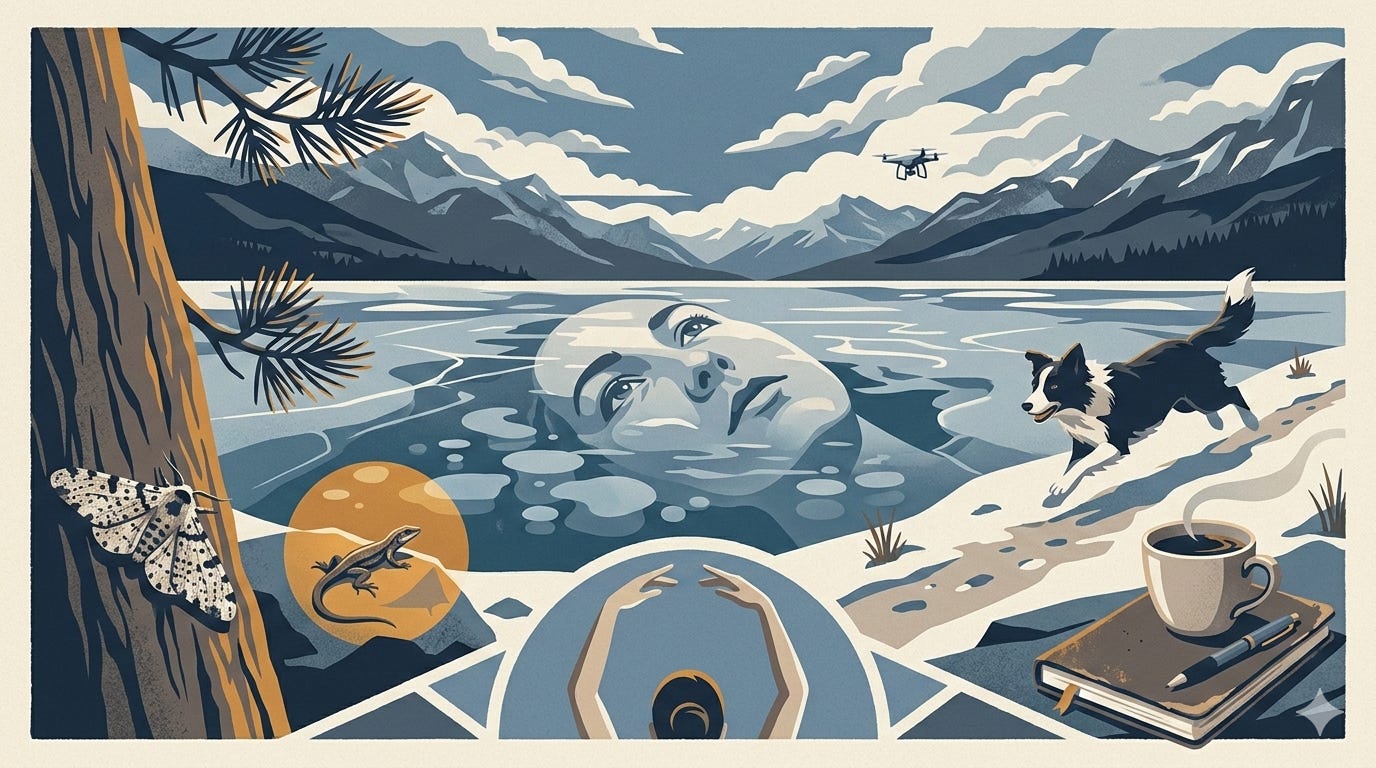
A portrait that will melt away
Yesterday, I posted a video as a Moment of Beauty in Daybreak Notes & Beans, and many of you wrote back to say how “amazing”, “gorgeous”, and “breathtaking” it was. A woman’s face, 23 metres across, was painted on the frozen surface of Abraham Lake in the Canadian Rockies. If you missed it, the video is in this Daybreak Notes & Beans newsletter.
The artist is David Popa, a portrait painter originally from New York, now based in Finland. He works on ice, sand, rock, and snow. Everything he makes is designed to disappear. Wind, weather, thaw. He put it plainly: “Nature always takes the final brushstroke.”
The Abraham Lake piece is titled “New Beginning.” It took two days in sub-zero conditions. He used chalk, charcoal, and water, applied with a hand-pump sprayer, using drone footage to keep proportions right while working at ground level. The lake itself is unusual. Methane from decomposing organic matter freezes mid-column under the ice, creating those white bubble shapes. Wind strips away the snow and leaves a glassy, deep-blue surface. Popa calls it one of the most beautiful and most difficult canvases he has ever worked on.
This piece is part of a series called “Renewal,” made in collaboration with Travel Alberta. He painted four large-scale portraits across the province, including works on canyon rock faces. All of them are gone now. Only the photos and videos survive.
He spends days on work he knows will vanish in weeks. No museum, no collector, no permanent object. I find that genuinely striking. Most artists make things to last. He makes things to disappear, and films the proof.
Here is one more video about his work:
Sleep, bears, and a free app
A recent Screen Skills newsletter on phone use and sleep sparked quite a few reactions in comments and DMs. The conversation has kept going, which tells me a lot of you are thinking about this. If you missed it, you can read that Screen Skills newsletter here.
Science News just published something worth adding to the pile. Not about falling asleep, but about using sleep to solve problems. Researchers found that specific sounds, played at the right moment during the transition into sleep, can nudge the brain toward directed dreaming. People woke up with solutions they couldn’t find while awake. The link is in the notes below.
Evelyne wrote about her own setup. She sleeps with the windows open and uses colored noise. She made a connection I hadn’t thought of: she works best in cafés and on trains, with that low ambient hum. “It keeps my brain occupied while I focus on work,” she wrote. She’s right about the mechanism. YouTube has hours of café noise, brown noise, and focus music worth exploring.
I recognize the advantages of working with café noise; this newsletter concept was born during coffee mornings in cafés, and the somewhat strange title still reflects those early mornings.
Then Brian, short and useful: he recommends the free version of an app called myNoise. No subscription, and you can mix your own sound environment. Worth bookmarking.
Evelyne also shared a story from the 1990s in Alaska. She stayed in a remote cabin. Total silence. Couldn’t sleep at all. Then she heard something moving on the gravel outside. Turned out to be a bear. That didn’t help either.
More on sleep and creativity
A personal note from last night: I spent most of yesterday (again) improving the imaging I use and went to bed with a few unsolved problems.
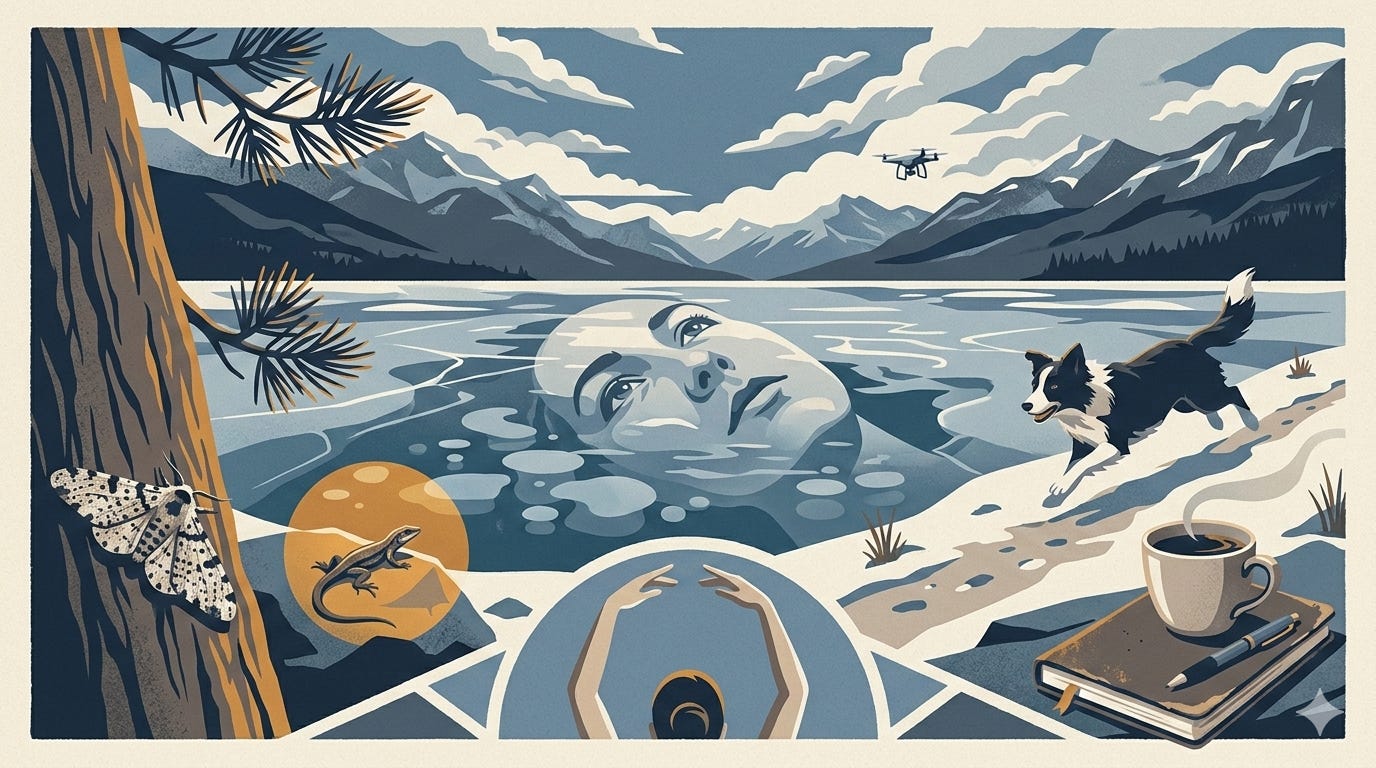
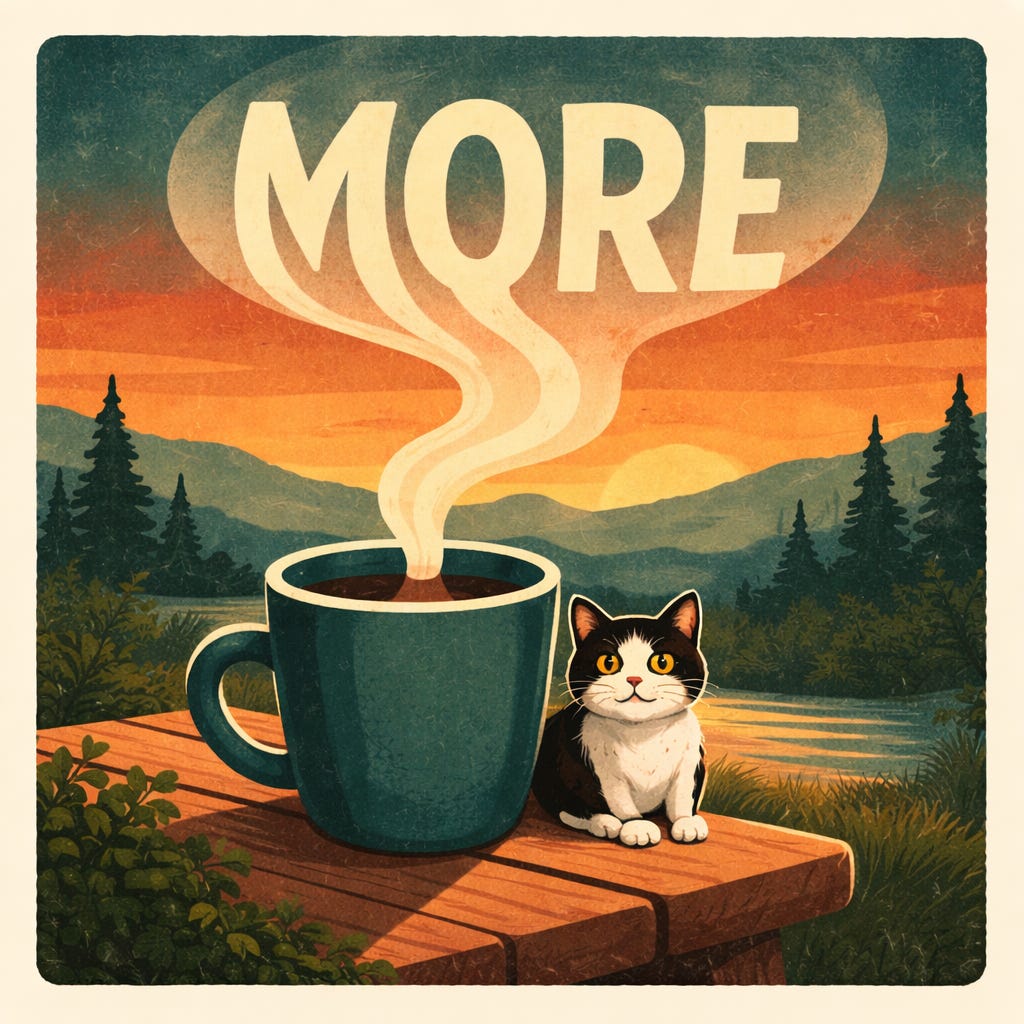
Did you notice the image at the top of this newsletter? I love it, I hope you do too, and it proves (for me at least) that I solved the imaging challenge I had been working on for quite some time. The solution was there when I woke up. I don’t recall thinking about it during the night, but somehow my brain worked it out. Was there any noise to help me? No, just silence. That works too.
I know many readers ignore the image, but for me it is an essential part of what I make. The poster to promote the post matches the design:
Frankie is healing
Do you remember that I wrote in Daybreak Notes & Beans about a man in Providence, Rhode Island, who found a large lizard while shoveling snow? She was nearly frozen, badly dehydrated, and frostbitten on her tongue and toes. Her name turned out to be Frankie, a female tegu, a large South American reptile, and probably someone’s escaped or abandoned pet. If you missed the story of February 2, you can read it here.
Popular Science has an update: Frankie is healing.
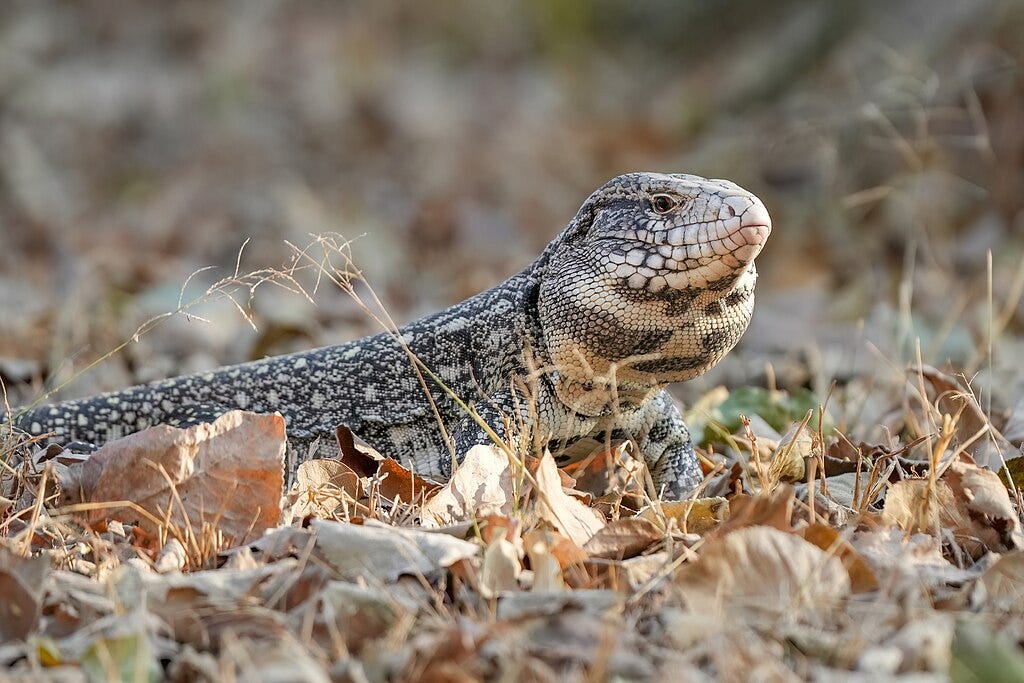
The tongue frostbite is the unusual part. The vets at the New England Wildlife Center couldn’t find a single published case of this in veterinary medicine. They turned to human medical literature and found a parallel. Now they remove dead tissue from the tongue every two to three weeks. Tongues heal fast. They are cautiously optimistic.
Frankie has moved from liquid to solid food. The vet described her likely future as “a warmer, if slightly less adventurous life.” That’s my favorite line of the week.
The asteroid is not hitting the moon
A quick update on asteroid 2024 YR4. Earlier, there was a small but real probability it would hit the Moon in 2032, about 4.3 percent. NASA’s James Webb Space Telescope has now confirmed it won’t. It will pass at roughly 13,200 miles from the lunar surface on December 22, 2032. A miss.
A few astronomers expressed mild disappointment. The impact would have been visible from Earth with the naked eye. You can’t please everyone.
More gives you what the other newsletters can’t: the rest of the story, answers to your questions, the additional context, updates on developing stories, the connections between topics, and the personal moments that don’t fit polished formats. If that extra layer matters to you, consider supporting this work:
Marta and the Swan Lake
After a piece on Parkinson’s disease and choir singing, TrishB wrote about music and the brain, and then mentioned a video she had seen some years ago.
A woman with Alzheimer’s disease, a former prima ballerina, no longer interacted with anyone. Then someone played Tchaikovsky’s Swan Lake.
TrishB wrote: “It was like observing a miracle.”
Her name was Marta González Saldaña. Born in Madrid around 1920, she spent years in Cuba and then in New York, where she danced with the New York Ballet in the 1960s. In 2019, she was living in a care home in Spain, deep into Alzheimer’s disease.
The Spanish association Música para Despertar — Music to Awaken — filmed what happened when they played Swan Lake for her. Her arms found the choreography she had danced more than fifty years earlier. The YouTube video pairs that footage with her original performance. Watching the two side by side is extraordinary.
She died in 2020, during the COVID lockdown.
TrishB was right; watch this video:
Yellow kitchens, two painters, and a closed museum
On March 1st, I posted a note on Van Gogh’s use of yellow after I wrote about it in this newsletter. The comments went somewhere unexpected.
Kathryn wrote that she had been thinking of painting her kitchen yellow. I replied that Monet painted his kitchen in Giverny yellow. Then Courtney jumped in: she had just painted her kitchen butter yellow.
Three people, two painters, one color. I enjoyed this exchange more than I can justify.
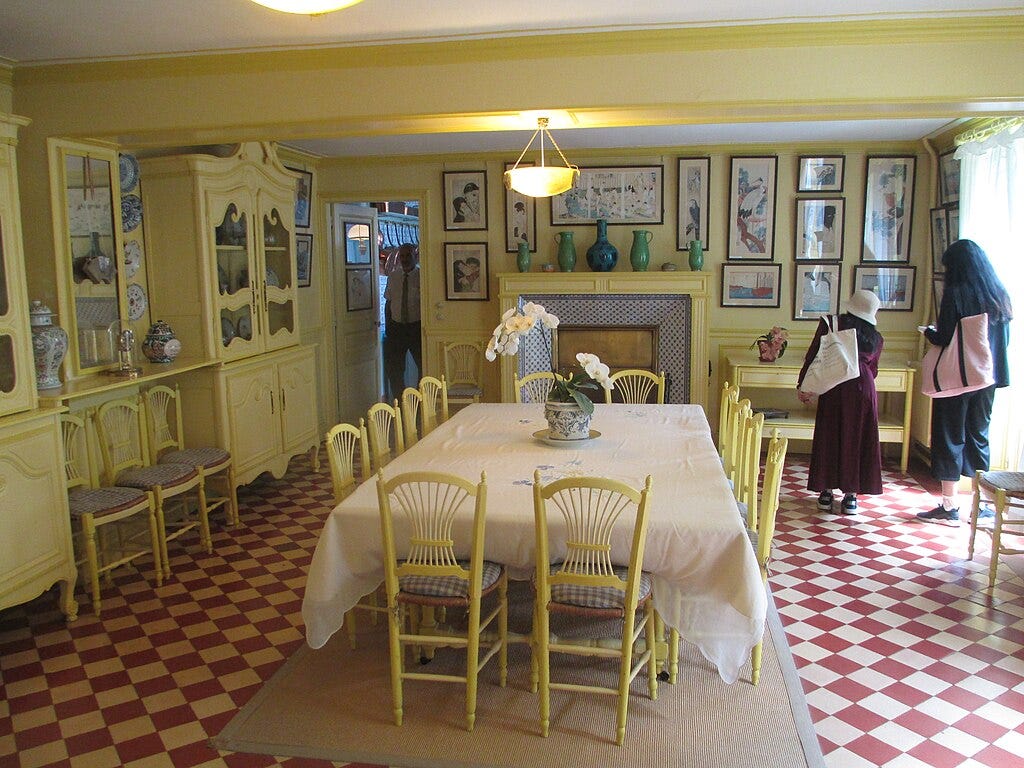
It also brought back memories of visits to Giverny; the last time I was there was already some 35 years ago. I still have the book my parents bought for me while we were there, with a birthday wish in my mother’s handwriting on the cover. And there are photos of that yellow kitchen; 35 years later, that memory just popped up when reading about the increasing use of bright yellow in Monet's time.
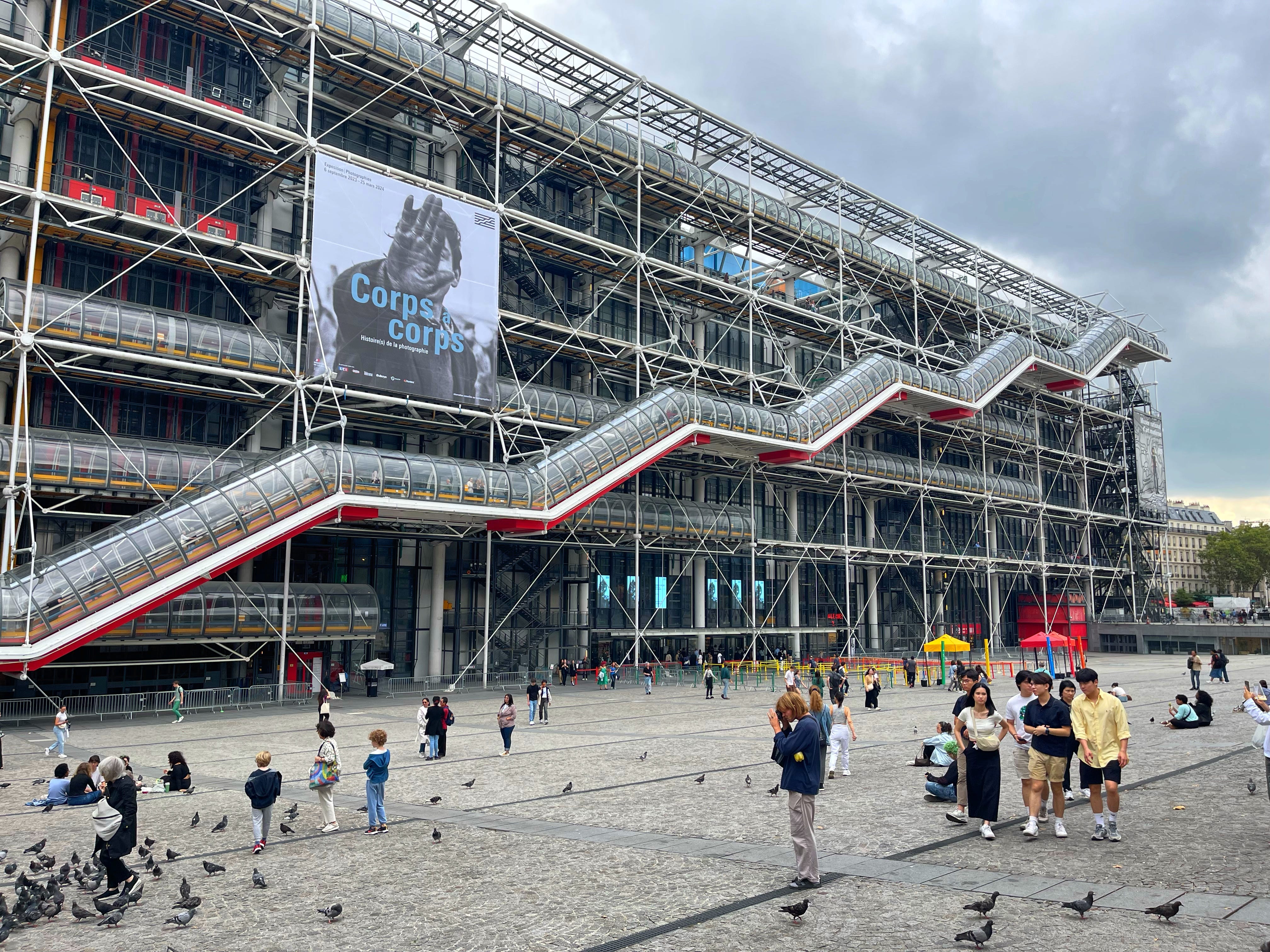
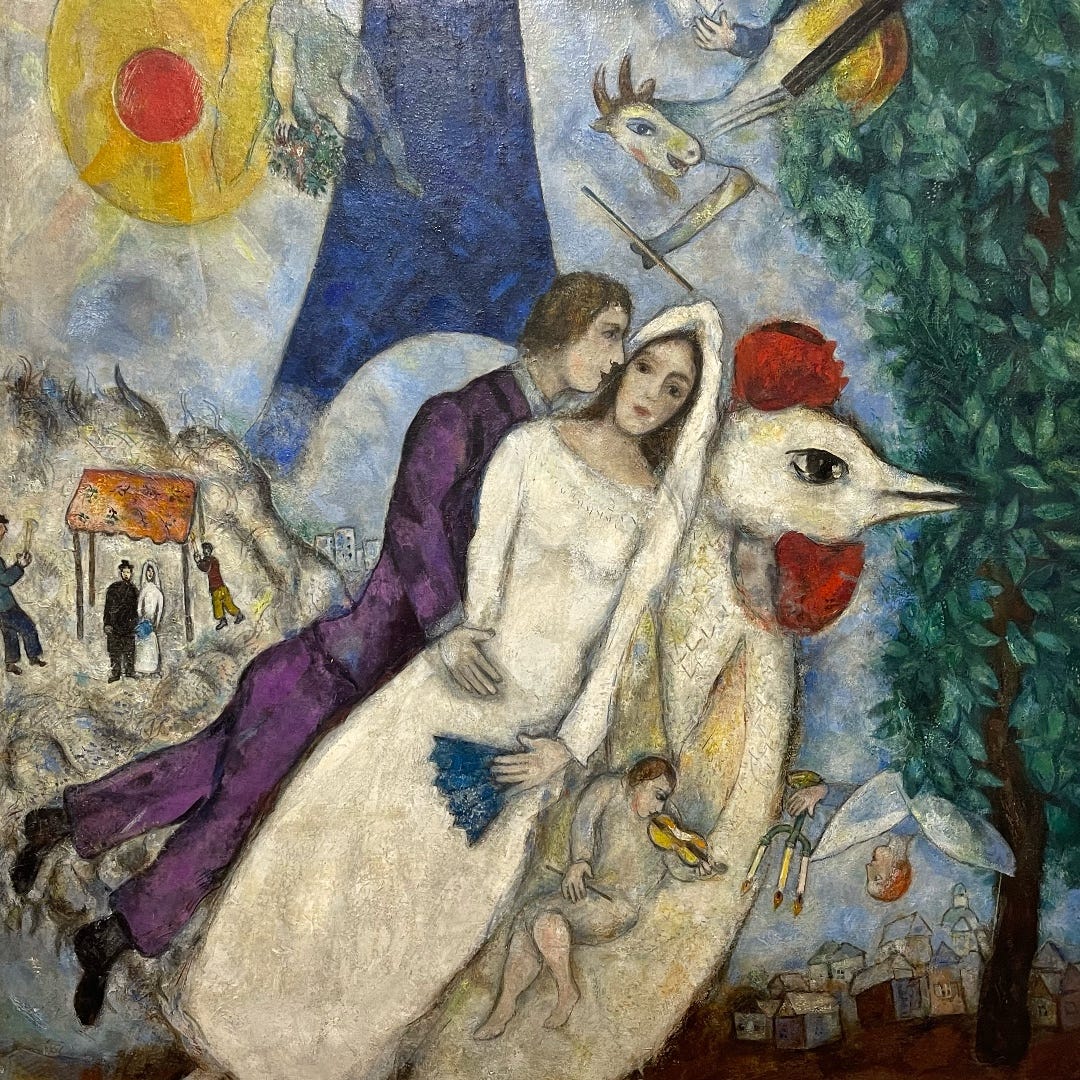
Someone also asked which floor I visit at the Centre Pompidou in Paris. It was the fifth, which holds the modern collection, from 1905 to the 1970s: Picasso, Matisse, Léger, Kandinsky, and Chagall. If you go, the sixth floor has the panoramic terrace with the best view of Paris, which is worth the climb on its own.
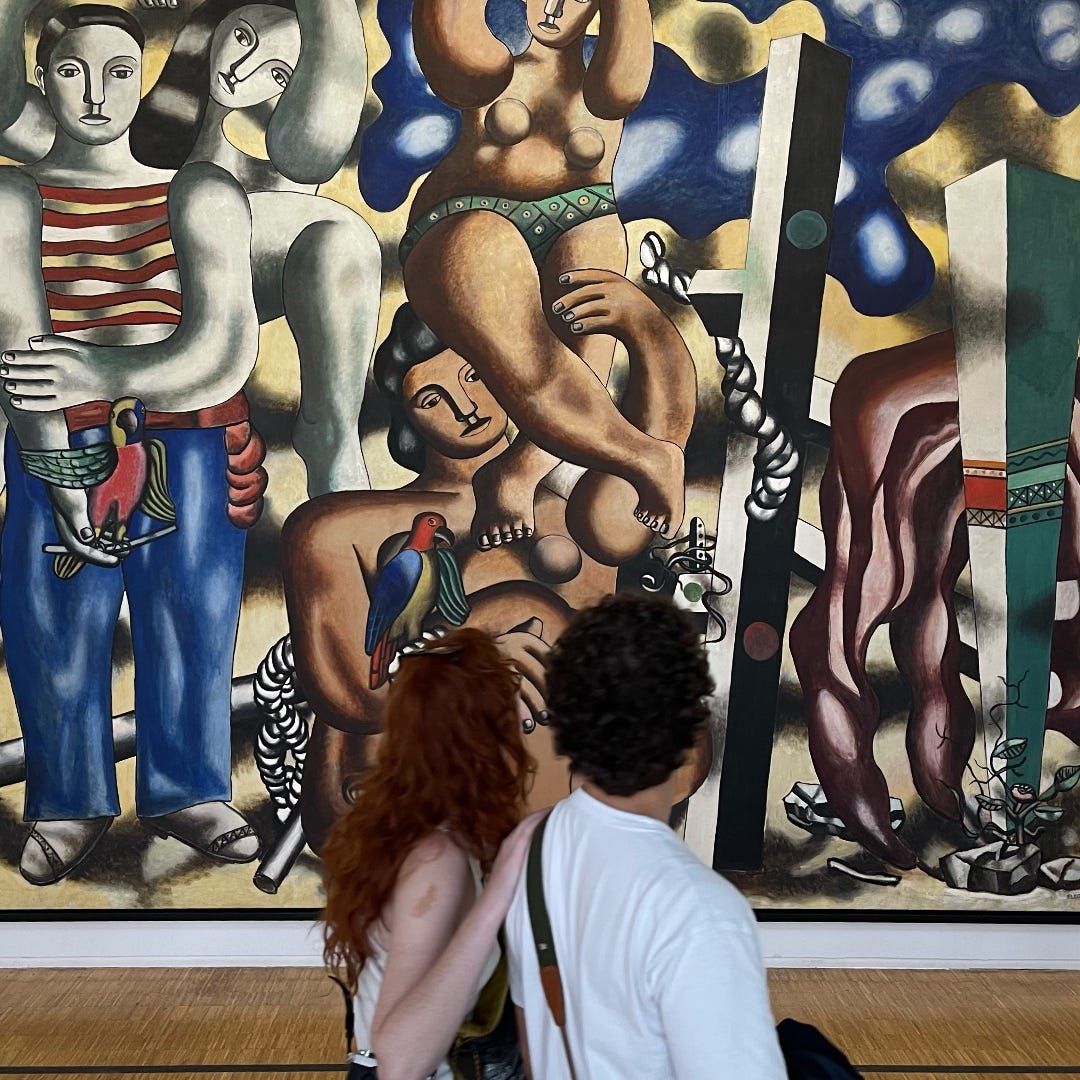
One thing, though. The Centre Pompidou closed in September 2025 for a full five-year renovation. Asbestos removal, new elevators, energy upgrades, and better accessibility. The building reopens in 2030. If you were planning a trip to Paris, the Pompidou is off the table for now. In the meantime, parts of the collection are on display at other venues across the city and internationally. The building will be better when it comes back. Five years is a long wait.
Video: Going up the escalator of the Centre Pompidou in September 2023; your second image of the Eiffel Tower in this newsletter.
Three border collies and a machine
I posted a video on Notes of a border collie playing Jenga with its owner. Border collies are the overachievers of the dog world, which makes them the natural stars of these videos.
A reader going by the name Unevieuxsac replied with a related story. She had a battery-operated ball thrower for her dogs. One dog understood the concept completely, retrieved the ball every time, and knew exactly where to drop it back. The other couldn’t have cared less. The enthusiastic one had one reservation: she loved the game but did not trust the mechanism itself.
I have a video of exactly this. Three border collies with an automatic ball launcher. They retrieve the ball, drop it into the machine, and the machine shoots it again.
Unevieuxsac’s dog wanted the game, not the technology. I find that a reasonable position.
The moth that changed color with England
Doreen left a detailed comment after I shared a caterpillar camouflage video on Notes and in “A Moment of Science”. She laid out the peppered moth story. It deserves more space than a comment reply.
Before the Industrial Revolution, peppered moths in England were mostly white with small dark markings. They rested on pale, lichen-covered tree bark. Birds couldn’t see them. A rare dark variant existed but stayed rare.
Then the coal-burning factories came. Soot blackened the trees across industrial England. The pale moths became visible. The dark ones didn’t. By the 1950s, about 90 percent of peppered moths near Manchester were dark. Natural selection, within a human lifetime.
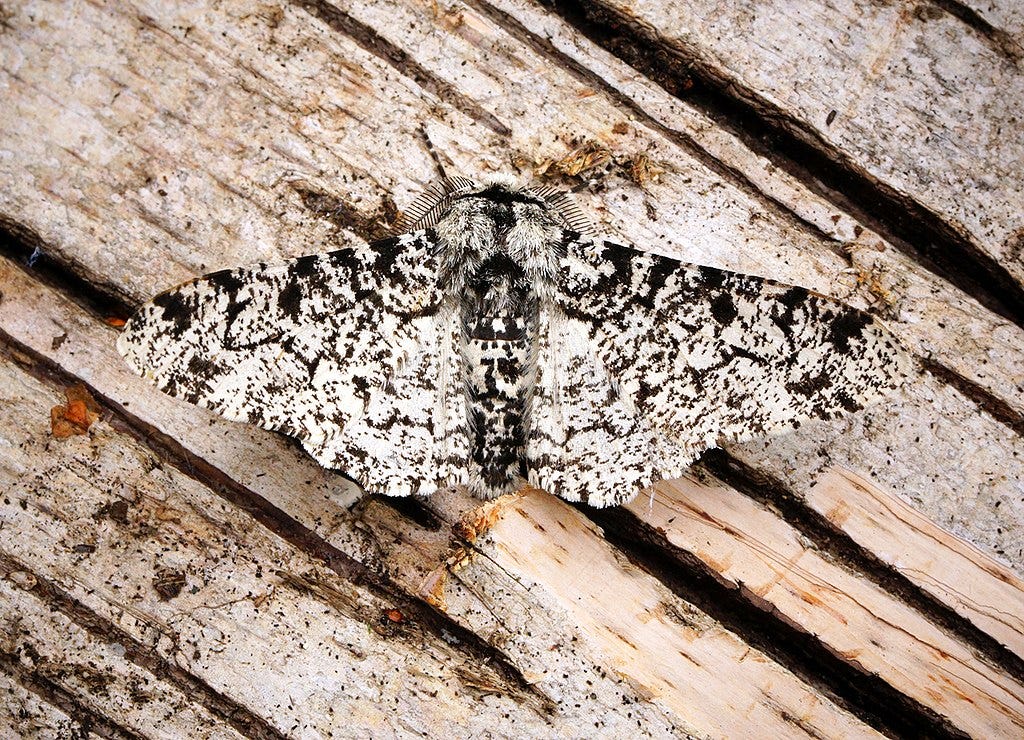
Then the Clean Air Act arrived. The bark lightened. The white moths came back. Today, more than 90 percent are white again. The same species, tracking human decisions across 150 years.
The story had one unsatisfying gap for a long time. Nobody knew the exact genetic mutation that caused the dark wings. Decades of research, no answer.
A study published in Nature finally found it. The mutation turns out to sit in a gene called cortex, which was known to affect cell division, not coloration. Nobody expected that. Researchers are still working out exactly how cortex shapes wing color, but the leading theory involves the tiny scales that cover moth and butterfly wings. Scales of different hues develop at different speeds, and the cortex may control that developmental rate.
The same gene, it turns out, also drives vivid wing patterns in tropical Heliconius butterflies. Moths and butterflies have been on separate evolutionary paths for about 100 million years. The same gene doing similar work in both groups is, as one Oxford evolutionary biologist put it, going to be in the textbooks for decades.
A Science article with the full details is in the notes below.
And here is a two-minute video:
A piece I wrote for the GeoIgnite Conference in Ottawa
Last May, I gave the opening keynote at the GeoIgnite conference in Ottawa. The organizers later asked me to write an update to an earlier article I had published in their publication on geospatial partnerships between Canada and Europe in a shifting political landscape. I didn’t really have time for an update, so I wrote a new article in the very early mornings before I started collecting Daybreak Notes & Beans stories. It is too detailed and technical for this newsletter, but it overlaps a bit with what I write in The Planet about international cooperation under pressure.
If that interests you: https://gogeomatics.ca/adapting-canadas-geospatial-partnerships-to-a-shifting-landscape/
More is less than two months old, and I’m building this newsletter the same way I built my other newsletters. By listening to what resonates and letting the concept develop naturally.
So if you have thoughts on what’s working or what you’d like to see, tell me. This space belongs to the community as much as it belongs to me.
Stay inspired,
Alexander
Supporting More means supporting the whole ecosystem of my work. Not just this newsletter, but the creative space where I answer your questions, follow up on developing stories, and explore ideas that eventually feed into The Planet, Daybreak Notes & Beans, and Screen Skills. If you value having access to that process, consider becoming a paid subscriber:
Don’t miss this one:
The Planet: a weekly newsletter examining American democracy, freedom of speech, and environmental policy through a European perspective. Having lived, worked, and traveled extensively in the US and beyond as a backpacker, diplomat, and journalist, I explore current events through historical context, showing how lessons from the past inform today’s challenges to democratic values and planetary health.
On Thursday, I shared part 4 in the “After the Fall” series in The Planet.


We’re really at the end of this newsletter, but there is always a bit more to share. For instance, have a look at my Patreon:
Yesterday, I published: Strao; The Island Ritual in Zeeland That Tells Me Winter Is Almost Over
There is no paywall. This week, I will post short updates on Patreon for my supporters about my travels in Portugal.
Or perhaps you enjoyed the newsletter and would like to support my writing by buying me a coffee?
I also write:
Screen Skills: the only tech newsletter on Substack specifically made for non-technical people. I share basic screen skills that any 20-year-old has instinctively developed in their reflexes, and that older generations often don’t even realize they need. These simple skills make your time on your phone and desktop more enjoyable. I promise to keep it really basic. Read it in three minutes, apply it in two minutes.
Have a look by clicking here:
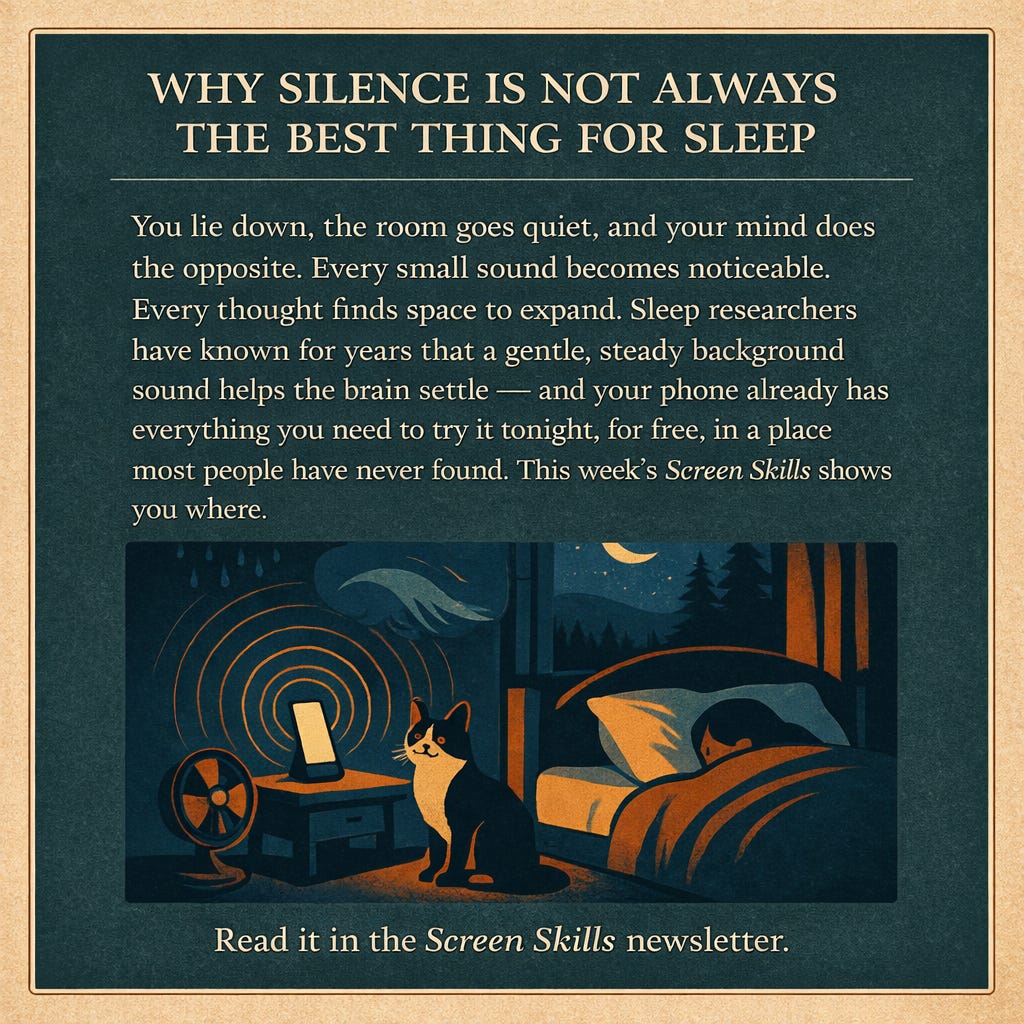
Read, for instance, this Screen Skills newsletter:
You’ll learn:
Why background sound helps some people sleep and what the research says
How to use the free sounds built into iPhone and Android
How to set a timer so sounds stop automatically after you fall asleep
The difference between white noise, brown noise, and nature sounds
Two apps worth knowing for more variety and control
How to use these sounds for focus and relaxation during the day too

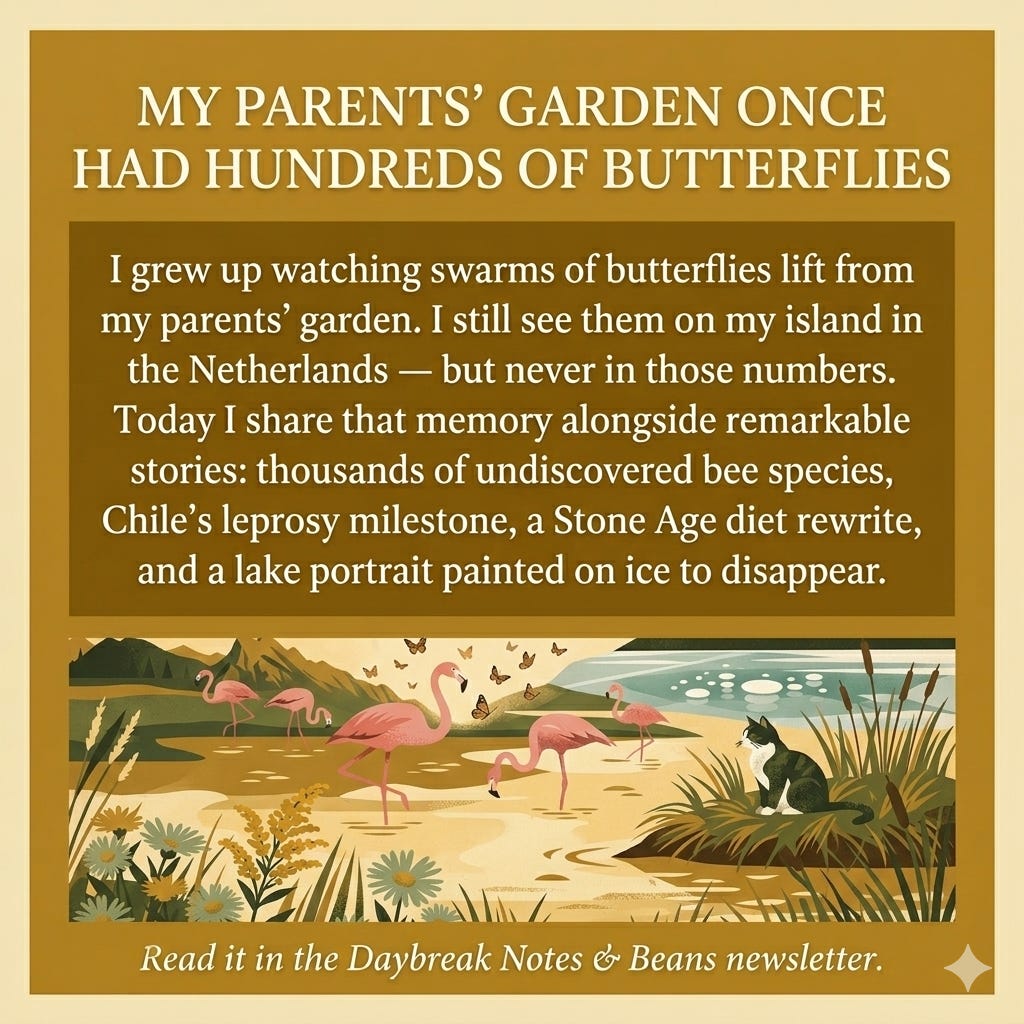
And there is one more newsletter, Daybreak Notes and Beans, focused on positive news to counterbalance the negative headlines you see all day. On most days of the week, I share ten uplifting news stories about science, health, art, travel, archaeology, or any other topic I think you’ll enjoy reading or that will give you hope now that we need it. Try it:
For instance:

Notes:
Sleep and problem-solving: Science News, “The right sounds may turn sleep into a problem-solving tool” — https://www.sciencenews.org/article/sleep-problem-solving-tool-lucid-dream
Frankie the lizard: Popular Science, “Frostbitten lizard found in Rhode Island is healing” — https://www.popsci.com/environment/frostbitten-lizard-rhode-island/
Asteroid 2024 YR4: Science Alert, “It’s Official: NASA Confirms Asteroid 2024 YR4 Will Fly Past The Moon” — https://www.sciencealert.com/its-official-nasa-confirms-asteroid-2024-yr4-will-fly-past-the-moon
Peppered moth: https://www.science.org/content/article/landmark-study-solves-mystery-behind-classic-evolution-story
David Popa / Abraham Lake: mymodernmet.com and bowvalleyinsider.com
GeoIgnite article: https://gogeomatics.ca/adapting-canadas-geospatial-partnerships-to-a-shifting-landscape/
video border collies: border.loyal on IG
"Nobody expected that."
You always gift us with the remarkable. And your illustration is remarkable! 💙
The David Popa story... an artist with the heart to let go of his beautiful work.
I'm sorry astronomers were disappointed 2024 YR4 will not, in fact, strike the moon 😂
Thank you TrishB for introducing us to ballerina Marta González Saldaña 🧡
Love how the collies work out their individual strengths during shared play.
Thanks for the escalator ride up Centre Pompidou and sharing your Gogeomatic update with us.
#More
I love the pictures. They do work well.
You reminded me that I meant to paint something in yellow and I did, but then I messed it up. I'll share when it's done.
I loved Centre Pompidou. Went to all floors because it was my first time.
I learned about that moth in school. Fascinating.
Still loving More.