

Your Questions Answered: Cat Games on iPad, Sacred Numbers, Figure Skating, and Édith Piaf
Plus: The pine tree growth continued, the mystery of the Cerne giant deepens, and Screen Skills questions answered

Eighty-nine comments on a cat video. Questions about monks, music, and chia seeds. A filmmaker who turns shadows into elephants. A road in Hungary that plays rock music when you drive on it. Reader questions arrived from Matt, Patricia, Jaine, and dozens more this week, and every single one led to a story worth following.
This is what More is all about; it’s where the stories continue.
Your cat can play games on your iPad
When I posted a video of cats trying to catch mice on an iPad screen, the reactions were overwhelming. Eighty-nine comments. Kelly mentioned the fishing game, though her cat Sullivan had to take a nap halfway through. Pam’s cat already uses the app, and she shared a video with us. George said his kitty loved iPad games. Nancy wanted one for Princess and asked where to buy it. David, Margaret, Julie, D.L., and Marilyn all asked for the app too. Carol used to have the game for her cat, but the iPad always ended up on the floor. Lady Bird wrote that her cats love to watch Animal TV or Pet TV, while her dog only watches dogs.
So let’s answer everyone at once.
The concept is simple. A mouse scurries across your iPad screen. Your cat sees it, pounces, and tries to catch it with their paws. The app registers each “catch” and keeps score. Some versions add sound effects, squeaking mice, or multiple prey animals at different speeds.
The New York Times recently published a full feature on pets watching screens. Science reporter Emily Anthes describes how her cat, Goose, gallops into the living room the moment he hears the TV turn on. One YouTube channel, TV BINI, has a video featuring black mice on a yellow background that has over 150 million views. The article explores a growing world of content made specifically for animals, and it turns out there is more pet entertainment on YouTube alone than any cat or dog could watch in a lifetime.
The science behind it is interesting. Older analog TVs flickered too fast for cats and dogs to follow comfortably. Modern digital screens eliminated that flicker, making them far more watchable for animals. Research confirms that cats observe animal videos with genuine attention, though they lose interest faster than dogs do. Dogs prefer watching other dogs. Cats prefer prey.
Here are four apps you can search for on your iPad or Android tablet (note that it depends on your device and country, but if you type these titles, you will surely find similar games if the one I describe is not available):
Mouse for Cats — A colorful mouse darts across the screen with squeaking sounds. After enough hits, a mini-game with multiple mice appears.
Game for Cats — Switch between a laser pointer and a mouse at varying speeds, with different mouse styles available.
Catch the Mouse — The simplest option. A counter tracks how many times your cat catches the mouse. Works best on iPad because the larger screen suits paw precision.
Cat Playground — Multiple prey options, including mice, fish, and lasers, with points for each catch.
Search the App Store for these titles or simply “cat game,” and they come up quickly.
This video shows a variety of effects, with every paw swipe leaving colorful digital paint trails. Your cat literally creates abstract art while playing. You can save the paintings as images. Think Jackson Pollock, but with whiskers.
One caution from the research: cats habituate quickly. If you play the same game every day, they lose interest. Rotate between different apps and videos. And supervise the screen time, because Carol’s experience is common. Not every cat reacts the same way, either. Some get overstimulated, others couldn’t care less. I still have to introduce Luna to these games; high time to work on her screen skills.
The pine tree that kept growing
Five days ago, I shared a Moment of Science video in Daybreak Notes & Beans showing the first 300 days after planting a pinecone. You watched a seed become a tiny tree in minutes. The video proved hugely popular when I also posted it on Notes.
Boxlapse, the creator of the original time-lapse, continued filming. Part two follows the pine through day 653. The tree outgrows its first pot and develops the kind of robust growth that turns a fragile seedling into a proper young tree. Boxlapse has promised that part three is in the works.
Stories that continue. That’s what More is for.
The song behind the Paris video
On February 8th, I shared a video by Onur Aslan featuring dreamy Parisian scenes that many of you loved. Several readers asked about the music. Jaine beat me to the answer: the group performing is Pomplamoose.
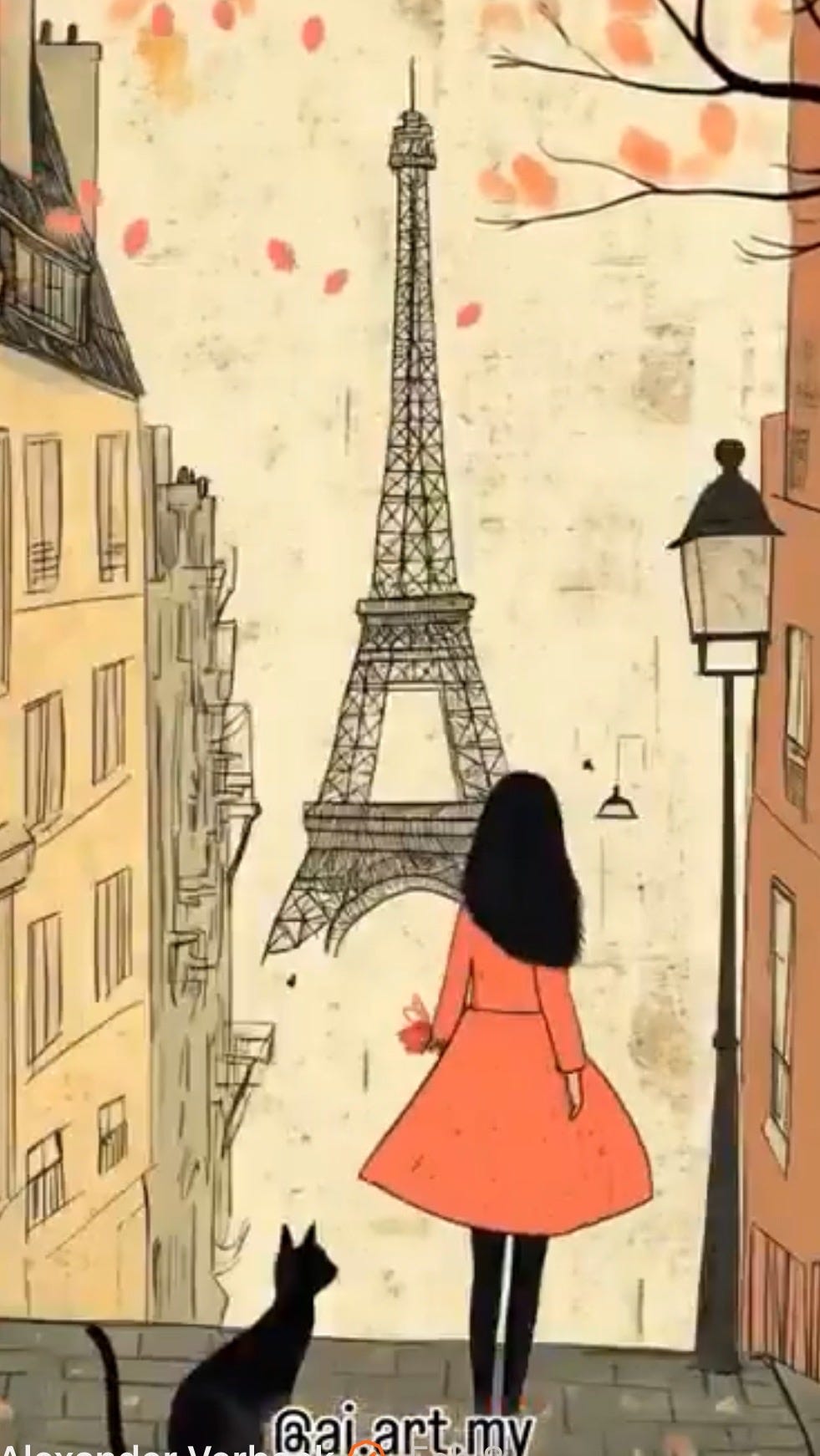
The song itself goes back much further. “Sous le Ciel de Paris” was written for a 1951 French film, with lyrics by Jean Dréjac and music by Hubert Giraud. Édith Piaf recorded it in 1954 and made it iconic. The lyrics personify the Paris sky as a jealous lover of the city, donning blue when happy, raining when sad, thundering in jealousy over the millions who adore the streets below. Piaf’s raspy delivery turned it into pure melancholy hope.
Pomplamoose’s 2019 cover features Nataly Dawn on vocals, Ross Garren on harmonica, and Jack Conte on keys and accordion. Their version adds indie-pop energy while keeping the original whimsy intact. It’s the perfect soundtrack for Onur’s rain-slicked streets and autumn leaves.
More gives you what my other newsletters can’t: the rest of the story, answers to your questions, the additional context, updates on developing stories, the connections between topics, and the personal moments that don’t fit polished formats. If that extra layer matters to you, consider supporting this work:
The Cerne giant: Hercules, Vikings, and a mystery that keeps unfolding
In the February 10th Daybreak Notes & Beans, I wrote about the Cerne Abbas Giant and the remarkable global fundraising campaign that saved its surrounding landscape. Donors from over 20 countries raised £330,000 in just 60 days. But I kept the story short, and this chalk figure deserves more.
The giant is 55 meters tall, carved into a Dorset hillside, and has puzzled historians for centuries. Was it a Celtic god? A fertility symbol? A satire of Oliver Cromwell? In 2021, National Trust scientists used a technique called optically stimulated luminescence on deep soil samples and dated the carving to somewhere between 700 and 1100 CE. That ruled out both prehistoric origins and the Cromwell theory.
Then Oxford researchers Helen Gittos and Tom Morcom took it further. Their study, published in the journal Speculum in January 2024, concludes that the giant was originally carved as Hercules. Not decoration. A rallying point for West Saxon armies mustering against Viking raids. The location fits: a spur jutting from a ridge with commanding views, close to major routes, with fresh water and estate supplies nearby. Hercules was well known in the Middle Ages, and interest in him spiked during the ninth century when Viking attacks intensified across Dorset.
By the eleventh century, monks at the nearby Cerne Abbey reinterpreted the figure as their patron saint, Eadwold. They wouldn’t have carved a naked saint from scratch, but they were happy to adopt an existing giant for their own purposes. From Hercules to hermit. The figure’s identity has been open to reinterpretation for over a thousand years.
The giant was entirely absent from historical records before 1694. No abbey documents mention it. Scientists found micro-snails in soil samples that confirm the hillside grassed over for centuries before someone rediscovered and re-cut the figure. An entire period of invisibility, then resurrection.
And the folklore is wonderful. Childless couples historically visited the giant’s rather prominent phallus, hoping for luck. Morris dancers still celebrate May Day at the Iron Age enclosure on top of the hill. A Time Team episode in 2025 explored connections between the giant and the lost Cerne Abbey, founded in 987 CE and dissolved in 1539, just 500 meters away.
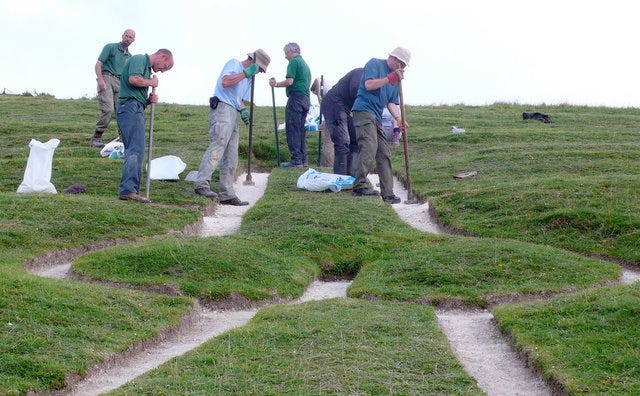
This summer, ten of those appeal donors will help pack 17 tonnes of fresh chalk into the giant’s outline to keep him visible for years to come. From Viking battle banner to butterfly sanctuary to community chalk-packing project. This hillside keeps finding new purposes.
Matt’s Screen Skills questions
Matt wrote: “I don’t know exactly where to ask questions, sorry if this is not the place.” Matt, this is precisely the place, the comments to any newsletter: Screen Skills, Daybreak Notes & Beans, The Planet, or More. You can also send a direct mail via the chat function.
He had three questions from the latest Screen Skills newsletter. Let me take them one at a time.
Filtering unknown texts on iPhone and iPad. Matt changed the notification settings on both devices and wondered whether they conflicted. Good news: they don’t. Your messages sync through iCloud, so texts appear on both your iPhone and iPad. But notification and filtering settings are device-specific. They stay separate. Changing one doesn’t affect the other, and they won’t interfere with each other. The downside is that you do need to set your preferred filters on both devices individually.

Unsubscribing from unwanted emails. Matt’s instinct is right to be cautious. If a legitimate company or newsletter shows a built-in “Unsubscribe” button at the top of the email in Apple Mail or Gmail, that’s safe to use. It routes through your email provider rather than directly to the sender. But if you have to click a link and type your email address into a suspicious-looking website, skip it. That can confirm your address for spammers. Rule of thumb: if you’re unsure, just mark the message as Junk instead. As for duplicates appearing in both your inbox and Junk folder: unsubscribing from the inbox version won’t automatically remove the Junk copies, but over time, your mail app learns to filter similar messages more accurately.
Travel Time update. Matt started using Apple Maps’ Travel Time feature and reports that it seems accurate for actual driving time. That’s been my experience too. It uses live traffic data and does a solid job of estimating drive duration under normal conditions. Just remember, it doesn’t account for parking, walking from your car, or local slowdowns at your destination. Think of it as a reliable starting point, then add a few extra minutes for real life.
Good questions, Matt. Keep them coming, everyone. Screen Skills answers land here when they don’t fit the tutorial format.
Supporting More means supporting the whole ecosystem of my work; not just this newsletter, but the creative space where I answer your questions, follow up on developing stories, and explore ideas that eventually feed into The Planet, Daybreak Notes & Beans, and Screen Skills. If you value having access to that process, consider becoming a paid subscriber:
Why the monks walked exactly 108 days
Patricia asked a great question after I reported on the Buddhist monks arriving in Washington DC following their walk from Texas: “Was the 108-day journey a coincidence? 108 is considered a very special, sacred number. Just curious.”
Not a coincidence at all, Patricia. The monks chose 108 days deliberately.

In Buddhism, 108 represents completeness. Buddhist prayer beads, called mala, have exactly 108 beads, each one marking a mantra recitation. A full cycle of 108 equals a complete round of purification. In some Buddhist cultures, New Year’s bells are struck 108 times to symbolize releasing the 108 human passions that stand between a person and enlightenment.
The math behind the number is elegant. Three types of feeling (pleasant, unpleasant, neutral) multiplied by six senses (sight, sound, smell, taste, touch, mind) gives 18. With craving or aversion, that doubles to 36. Across past, present, and future, 36 becomes 108.
By walking for exactly 108 days, the monks turned the entire journey into a living prayer. Each day of walking functioned like one bead on a mala. When they arrived in Washington on day 108, the pilgrimage was spiritually complete.
The road in Hungary that plays music when you drive on it
You may remember the kinetic mural in Indio, California, where horses gallop, and eagles soar when you drive past at highway speed. I covered it in Daybreak Notes & Beans and then expanded the story in last week’s More with Rick’s research on Muybridge and Haven’s Seabiscuit connection.
Hungary took a similar idea and applied it to the road itself.
On Route 67, between Kaposvár and the M7 motorway, engineers carved grooves into the asphalt at precise intervals. Drive at exactly 80 km/h, and your tires become an instrument. The road plays a 30-second snippet of “A 67-es út” (”Road 67”) by the Hungarian rock band Republic. The song matches the road’s name perfectly.
The engineering is clever. Different gap widths produce different notes. A 61-millimeter gap vibrates at the frequency of an E note at that speed. Drive too fast or too slow, and the melody garbles, which doubles as a safety feature nudging drivers to obey the speed limit.
The road was built in 2019 as a tribute to the band’s late lead singer László Bódi, known as Cipő. Engineers from Strabag and Soltút designed the musical strips during a road-widening project. Hungary liked the concept so much that two more singing roads followed: Route 37 plays a children’s folk tune called “The Grapes are Ripening” (added in 2023), and Highway 21 plays “Nélküled” by Ismerős Arcok (added in 2024).
They’re not alone globally. Japan has a road that plays a Kyu Sakamoto ballad. The United States has one that plays “America the Beautiful.” However, I prefer Hungary’s version, where a rock band tribute is built into the national infrastructure.
That’s it for this week. If you have thoughts on what’s working or what you’d like to see in More, tell me. This space belongs to the community as much as it belongs to me.
Stay inspired,
Alexander
More gives you what the other newsletters can’t: the rest of the story, answers to your questions, the additional context, updates on developing stories, the connections between topics, and the personal moments that don’t fit polished formats. If that extra layer matters to you, consider supporting this work:

If you missed some of my recent newsletters, here they are:
Yesterday, I published this one in The Planet:

The day before, on Friday, I published Daybreak Notes & Beans:

And that day, Friday, I also published Screen Skills:

Still here?
With the Winter Olympics in full swing, several of you have been enjoying the ice dancing videos I’ve shared over the past weeks. Here’s one more, and it might be the best.
At the 1992 Albertville Winter Olympics, Czech figure skater Petr Barna stepped onto the ice for the exhibition gala dressed as Charlie Chaplin’s Tramp. Bowler hat, mustache, baggy pants, cane. He was 18 years old. He had just placed fifth in the men’s singles competition, but this unjudged gala performance stole the entire show.
Barna stumbled, wobbled, and slid across the ice in perfect slapstick fashion, then turned each fall into an elegant spin or lift. Chaplin’s film scores played overhead. The audience loved every second. Born in Czechoslovakia in 1973, Barna competed for the newly independent Czech Republic after the Velvet Revolution. He had won European Championship silver in both 1991 and 1992 before injuries cut his competitive career short.
The routine resurfaced on social media recently amid Winter Olympics nostalgia, and it holds up beautifully. The quality of the recording is not as it should be, but good enough to give an impression.
Notes
Cat iPad apps: Apps available on Apple App Store — search “Mouse for Cats,” “Game for Cats,” “Catch the Mouse,” “Cat Playground,” or “Paint for Cats”
Pine tree time-lapse: Boxlapse on YouTube
“Sous le Ciel de Paris”: Original by Édith Piaf (1954), lyrics by Jean Dréjac, music by Hubert Giraud. Pomplamoose cover (2019) featuring Nataly Dawn, Ross Garren, and Jack Conte
Cerne Abbas Giant research: T. Morcom & H. Gittos, ‘The Cerne Giant in its Early Medieval Context,’ Speculum, January 2024 — https://www.journals.uchicago.edu/doi/10.1086/727992
Cerne Abbas Giant fundraising: National Trust — https://www.nationaltrust.org.uk
Oxford research summary: University of Oxford — https://www.history.ox.ac.uk
108 in Buddhism: Buddhist Temple San Diego; Enlightenment Thangka
Vincent Bal: Instagram @vincent_bal — https://www.instagram.com/vincent_bal/ | My Modern Met, ‘Artist Turns Shadows from Everyday Objects into a Cast of Playful Characters’ — https://mymodernmet.com/shadow-art-vincent-bal/
Hungary singing road: Route 67, between Kaposvár and M7 motorway. Built 2019 by Strabag and Soltút
Petr Barna: Exhibition gala, 1992 Albertville Winter Olympics, February 22, 1992
"I still have to introduce Luna to these games; high time to work on her screen skills."
😂 Cats and dogs and screens. I know cats who will unplug the tv if they are kept from their programs. Thanks for the app suggestions. Painting For Cats!
Love the pine tree history.
Thank you Jaine and Alexander for the Pomplamoose info and video. I love their version. And thank you, Paris 🧡
There is so much in this newsletter to capture our attention. Pomplamoose with Nataly Dawn will be added to my playlist. It was interesting to learn that she is American.
As I continued to read, I found the article on the monks and 108 days. I had not thought of it being significant and will take the time to research this further.
These were just the two that stood out to me. The others were fascinating as well. It would take a page to comment on each topic. As always, I learned so much from reading your newsletters. I really appreciate your work.