


Earlier today I published two newsletters. No Morning Compass on Sundays — I use the day differently. But today was a big publishing day, and I wanted to talk you through both pieces.
The transcript is below for those who prefer to read.
Morning Comments 🎙️ is a video companion to Morning Compass 🧭, my daily briefing. Both are published in More ✍️. If you find this kind of independent analysis useful, consider becoming a paid subscriber:

You can read this weekend’s full Morning Compass briefing here:
Transcript
There’s no Morning Compass today. It’s Sunday. I took a day off from the daily briefing. But today I published two pieces that I want to tell you about, because they deserve more than just another link in Notes.
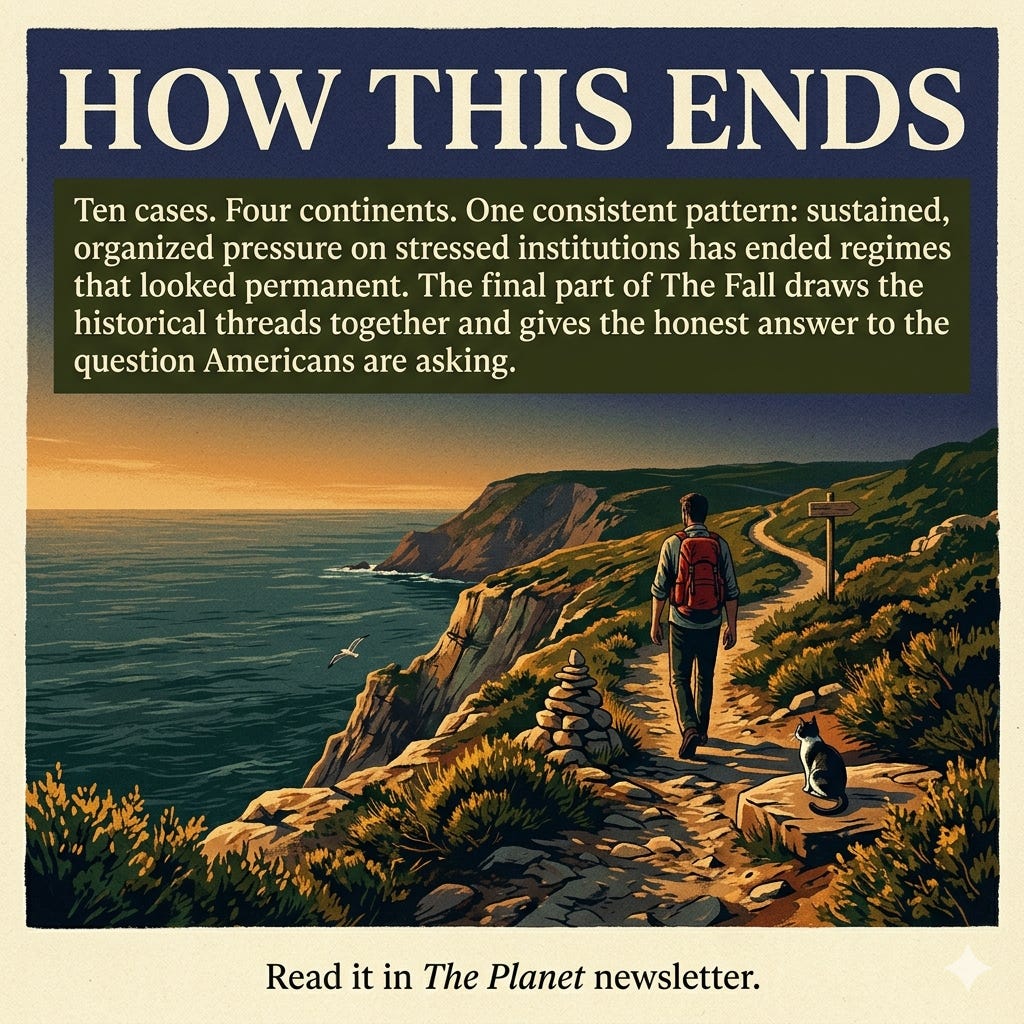
Let me start with the heavier one: that’s part ten of The Fall in The Planet. It’s the final article in this series.
If you have been following this series, you know what it is about. How authoritarian regimes end. Nine case studies —
Portugal, the Philippines, East Germany, Czechoslovakia, Romania,
Chile, South Korea, Ukraine. Each one a different combination of triggers, a different turning point, and a different morning after.
Part 10 pulls it all together. Where does America stand against each of the five triggers the political science literature identifies? What do the historical cases actually teach? And what can Americans do?
This series began because of a conversation on a coastal trail in Portugal in March 2026. Three Americans I was walking with asked me a question. Not about the trail, but about Trump’s America:
“How does this end?”
Ten parts later, I have given them the best answer that the historical record can provide. It is not a prediction. It is a pattern.
And the pattern is this. Regimes that have faced the simultaneous activation of economic anxiety, elite fracture, sustained mass mobilization, contested military loyalty, and international isolation have not remained unchanged.
The Czechs who filled the streets in November 19-eighty nine did not know that Havel would be president in six weeks. The Chileans who voted “No” in 1988 did not know that the generals would refuse to sign that night.
But they showed up anyway.
That is the piece. I published it in The Planet today. And if you know an American who is asking the same question that those hikers asked on that Portuguese trail, send it to them.
Now the lighter piece that I published today in The Curious Wanderer.
Some of you have been with me since Patreon. For years, my travel writing lived there — it was mostly behind a paywall, for a small community of people who wanted to follow me on the road. I loved that community. I still do.
But when I walked Portugal’s Fisherman’s Trail in March 2026, I ran into a problem. Patreon’s technical limitations made it nearly impossible to publish properly from the trail. I was walking every day, I had stories I wanted to tell, and the platform kept getting in the way.
So I created The Curious Wanderer on Substack. And I moved the travel writing there.
The Portugal series ran for many weeks. I described the Atlantic cliffs. The fishing villages. The cork forests. The history of a coastline that sent ships to every corner of the world. And I loved writing those pieces.
And now I have moved to a new series where I take you to The Netherlands. A walking route through old Hanseatic cities along the river.
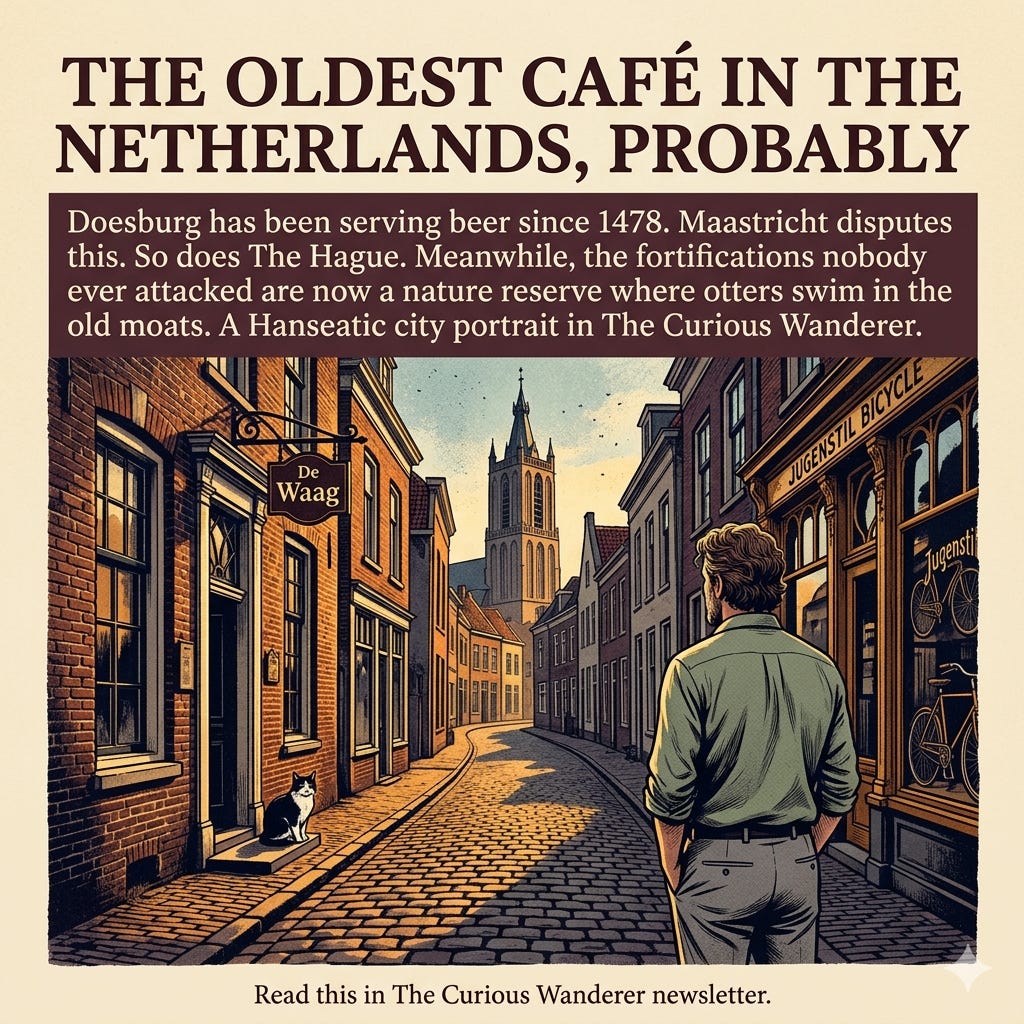
Today’s piece is about Doesburg. A small city in the eastern Netherlands that most people have never heard of. It has a café that holds a Guinness record as the oldest continuously operating café in the country — serving beer since 1478. It has fortifications designed by the great Dutch military engineer Coehoorn, built around 1700. The are so perfectly preserved that they are now a nature reserve, with otters in the old moats. And cuckoos on the ramparts.
And it has a 1904 shopfront, tiled in Art Nouveau style, and built for a bicycle manufacturer. It is decorated with wheels and stylized flowers. The bicycle was revolutionary in 1904. This shopfront treated it like a cathedral window.
Standing in front of that shopfront, I thought about my grandfather. He was born in 1900 in a small village not far from Doesburg. He told me once that he remembered the first bicycle arriving in his village. The whole community came out after Sunday church to watch the village doctor circle the square on this strange machine. My grandfather remembered the doctor’s expression clearly. A man who knew he was the center of attention. And was enjoying every second of it.
I love it when a walk connects like that.
There is also a more personal thread in today’s piece. The fortifications in Doesburg were used during the Second World War — not to keep enemies out, but as cover by an occupying German force trying to slow the Canadian advance. The Canadians pushed through and continued west. Other units from the same army liberated Amersfoort a couple of weeks later.
My father was hiding in Amersfoort at that time. A young man. In hiding for the occupying Nazi-German army.
The Netherlands walk is not finished. I walked the Doesburg stretch last summer and there is more trail ahead — north along the river toward Kampen. I have walked only a part of this trail, and I hope to continue later this year. When I do, I will write about it in The Curious Wanderer.
For now, today’s piece is there. Doesburg. A city that carries more history than its eleven thousand people might suggest.
So there you have the two pieces of today. One about how democracies survive. One about how a walk connects you to people who came before you.
Thank you for reading. And for watching. I’ll see you tomorrow on Substack.
You can read the two articles of today here:


Morning Comments 🎙️ is a video companion to Morning Compass 🧭, my daily briefing. Both are published in More ✍️. If you find this kind of independent analysis useful, consider becoming a paid subscriber:


