

🧭 Starmer Resigns After the Epstein Files Reached London. Washington Remains Untouched.
🧭 Morning Compass — Monday, June 22, 2026

More, including Morning Compass 🧭, gives you the deeper context, a historical frame, and a European angle on the news you are already following. If that layer of the story matters to you, consider supporting this work:
What’s the news
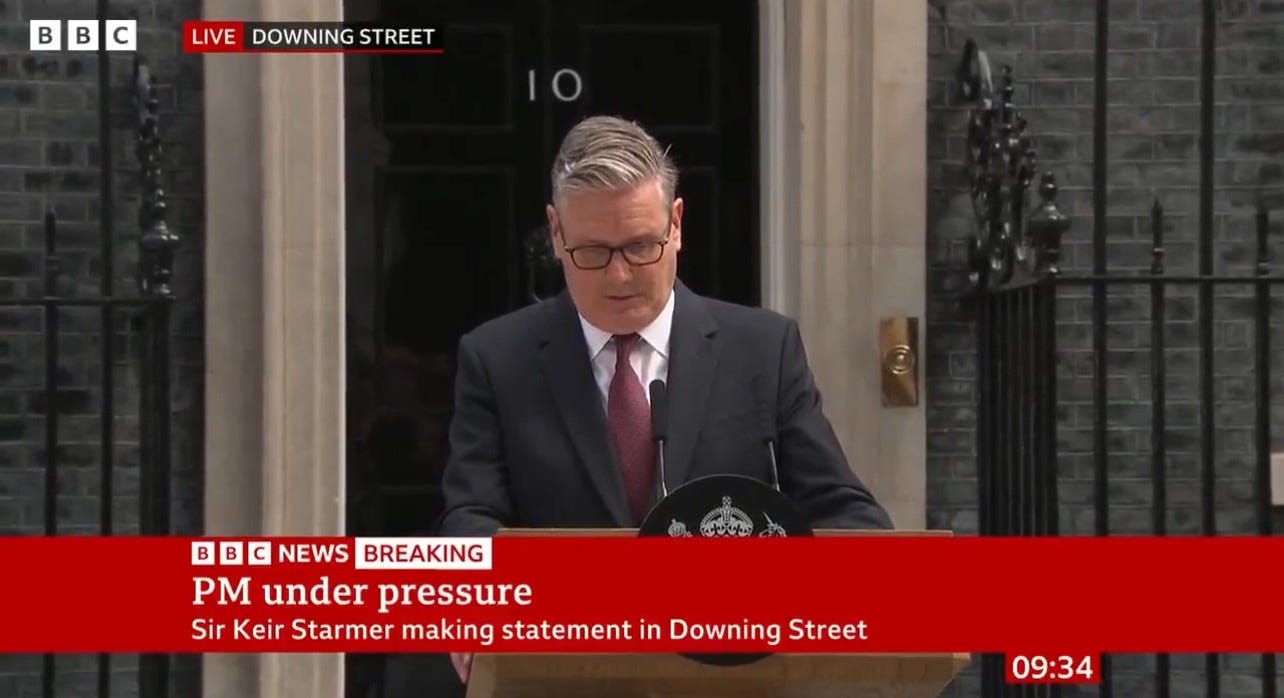
Keir Starmer resigned this morning as British prime minister, less than two years after leading Labour to its biggest election victory since Tony Blair’s 1997 landslide. He stood outside 10 Downing Street, voice breaking, and said his party had told him he was no longer the right person to lead them into the next election. He accepted that verdict with what he called “good grace.”
Britain will now have its seventh prime minister in a decade.
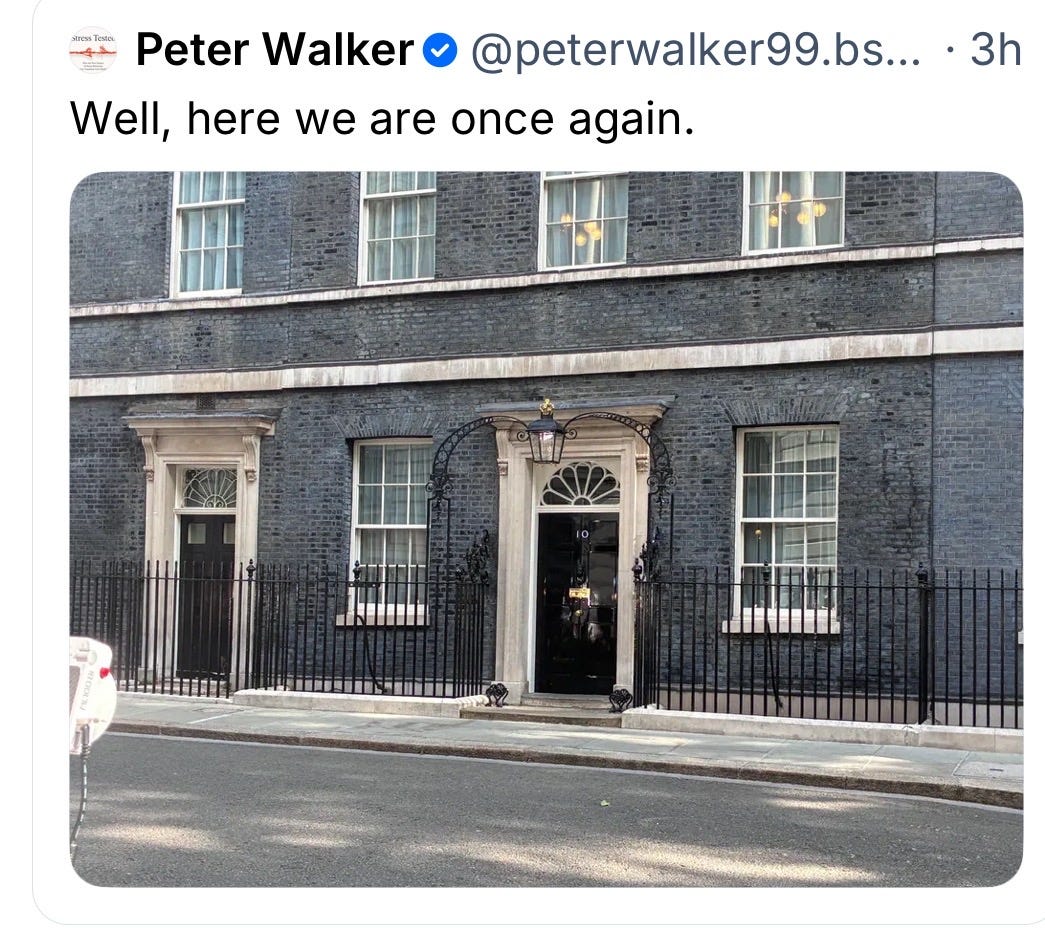
The resignation had been coming for months. Starmer arrived in office in July 2024 promising stability after years of Conservative chaos. He lasted 23 months. That is longer than Liz Truss, who lasted 45 days, but the trajectory was the same: a government that never found its footing, that reversed itself repeatedly on welfare cuts, winter fuel payments, inheritance tax for farmers, and foreign aid, and that lost the public’s trust before it had fully won it.
The fatal blow was Peter Mandelson.
Starmer appointed Mandelson as British ambassador to Washington in late 2024, calculating that the Labour grandee’s connections and trade expertise would help navigate Donald Trump’s second term. It worked, briefly. A trade deal was secured. Then the Epstein files arrived.
Mandelson’s name appeared repeatedly in documents released by the US Justice Department in January. Emails showed him sharing sensitive government information with Epstein in 2009, when he was a Cabinet minister. He had previously described Epstein as his “best pal.” He had continued the friendship after Epstein’s 2008 conviction for sex offenses. When these details emerged, Starmer sacked him. Then it came out that Mandelson had failed his security vetting before the appointment. Then it emerged that Downing Street had known about the failed vetting and said nothing. Each revelation was worse than the last.
The Epstein scandal destroyed a British prime minister. In the United States, roughly half the Epstein documents remain unreleased. The named American figures in those files — men of wealth and political influence — have faced nothing. A British politician who befriended Epstein has lost his career and now faces a police investigation for misconduct in public office. American politicians and businessmen in the same files carry on as before. That gap says something about where accountability lands and where it doesn’t.
The Mandelson scandal was not the only problem. Starmer’s Labour Party suffered catastrophic local election losses in May, losing councils held for decades to Nigel Farage’s Reform UK. Reform now polls at 25% nationally, seven points ahead of Labour. The party that swept to power with 411 seats in 2024 now polls at 18%.
What finally forced the issue was Andy Burnham. The former mayor of Greater Manchester ran for a parliamentary seat in Makerfield specifically to challenge Starmer. He won by 9,231 votes, taking 55% of the vote, defeating Reform and defying national trends. The scale of that win made clear what Labour MPs already knew: Burnham could beat Farage in ways Starmer couldn’t.
By Sunday evening, cabinet ministers were telling Starmer privately that his time was up. Over 100 MPs had signed a letter demanding a change. He spent the weekend at Chequers with his family and made his decision.
The succession looks likely to be swift. Burnham confirmed he will run. Wes Streeting, who had resigned as health secretary over Starmer’s leadership, immediately backed Burnham rather than enter the race himself. Nominations open July 9 and close when Parliament rises on July 16. If Burnham runs unchallenged, he could be prime minister as early as July 17 or 18.
Tomorrow is the 10th anniversary of the Brexit referendum. The timing is not subtle. That vote triggered the first prime ministerial departure of this decade of revolving doors. Ten years later, the churn continues. David Cameron, Theresa May, Boris Johnson, Liz Truss, Rishi Sunak, Keir Starmer — six gone before completing a full term. The country that voted for Brexit to “take back control” has had less political stability than almost any other European democracy in the decade since.
The European reaction to Starmer’s departure was notably warm. European Commission President Ursula von der Leyen wrote that European and Ukrainian security were stronger because of him. Norwegian Prime Minister Jonas Gahr Støre thanked him for a close partnership and pointed to a historic defence agreement between their countries. These tributes reflect what was visible throughout Starmer’s tenure: he was more effective on the international stage than at home. He rallied European support for Ukraine, pushed for a Brexit reset with the EU, kept Britain out of Trump’s Iran war, and secured a trade deal with Washington that spared the UK the worst of the tariffs.
None of it was enough to save him domestically.
What to watch today
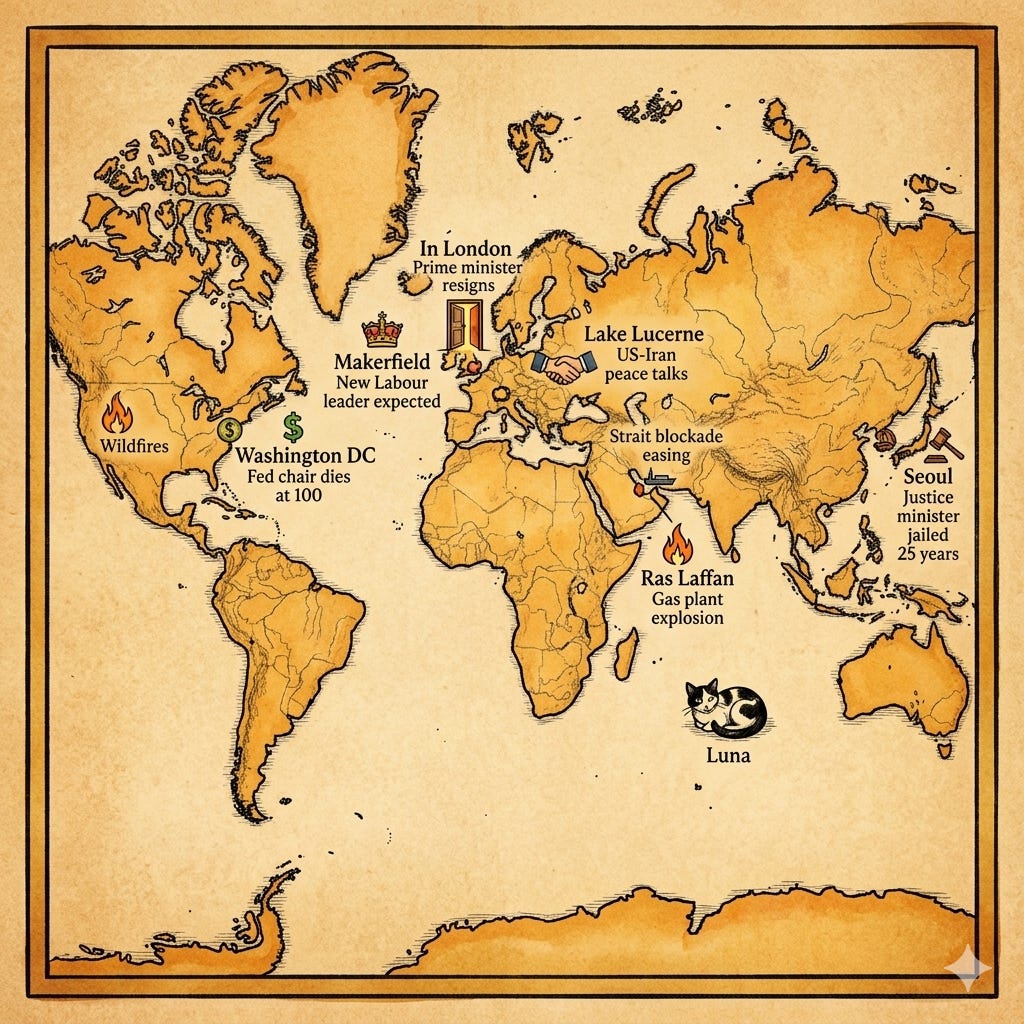
Iran peace talks. The first round of US-Iran negotiations in Switzerland ended in the early hours of Monday with what mediators Qatar and Pakistan called “encouraging progress.” The talks lasted 18 hours. JD Vance called the outcome a “good foundation” for a final deal. The concrete agreements are significant: a mechanism to de-mine the Strait of Hormuz, a de-confliction cell to enforce the Lebanon ceasefire, and Iran’s agreement to allow IAEA nuclear inspectors back into the country for the first time since the US and Israel struck Iranian nuclear sites. Vance also outlined a proposal — credited to Jared Kushner — to unfreeze some of Iran’s estimated $24 billion in frozen assets, on the condition that the funds are spent on US agricultural goods rather than used to fund armed groups. Iran’s central bank governor said the necessary documents were signed.
The talks were repeatedly jolted by Trump posting threats on social media while negotiators were in the room. At one point Iran’s delegation walked out in protest at a Trump post threatening resumed US attacks. They returned and talks continued. The Iranian senior delegation has now left for Tehran. Technical working groups remain in Switzerland to continue negotiations this week.
The 60-day window to settle Iran’s nuclear program has not yet produced a deal on that central question. Iran’s position — never backing down from the right to enrich uranium — has not changed. One US economist warned Monday that Iran is likely to string out talks until January 2029, when a new American president takes office. Oil prices fell nearly 2% after the Swiss talks. Brent crude was at $79 a barrel Monday morning, still 32% higher for drivers at the pump than before the war began.
A complication: a gas plant explosion at Qatar’s Ras Laffan industrial complex late Sunday injured at least 54 people and left 18 missing. Qatar is one of the world’s largest LNG exporters and also the primary mediator in the US-Iran talks. The facility had been shut down since early in the war; it was attempting to restart operations when the blast occurred. An Iranian missile attack in March had already caused significant damage to Ras Laffan.
South Korea. A Seoul court sentenced former justice minister Park Sung-jae to 25 years in prison for his role in ousted President Yoon Suk Yeol’s brief martial law imposition in December 2024. Park was found to have ordered officials to assess detention capacity at prisons and prepare for possible arrests of politicians. Yoon himself received a life sentence for rebellion. Several other Cabinet members are now serving long sentences.
US wildfires. An uncontained blaze in Utah’s Juab County has burned 34 square miles and forced the evacuation of Eureka, population 1,000. A separate fire near Sedona, Arizona, has burned 300 acres. Temperatures are forecast to reach 42 degrees Celsius (108 degrees Fahrenheit) in parts of New Mexico this week.
More, including Morning Compass 🧭, gives you deeper context, a historical frame, and a European angle on the news. If that layer of the story matters to you, consider supporting this work:
On this day
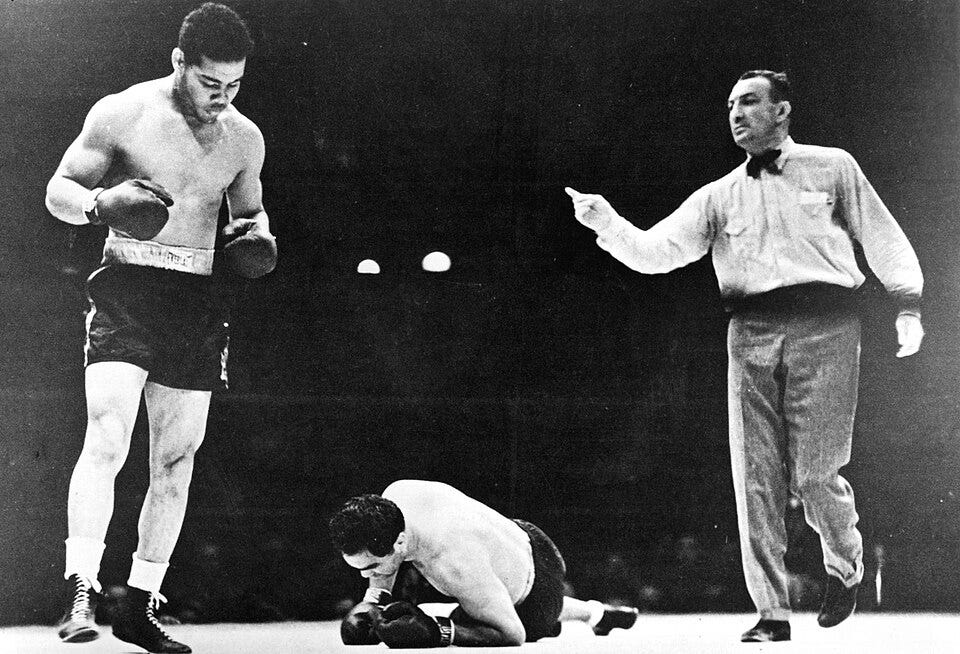
On June 22, 1938, Joe Louis knocked out Max Schmeling in two minutes and four seconds at Yankee Stadium to retain his heavyweight title. The fight carried enormous symbolic weight: an African American man defeating a German boxer in front of 70,000 spectators as Nazi Germany was building toward war.
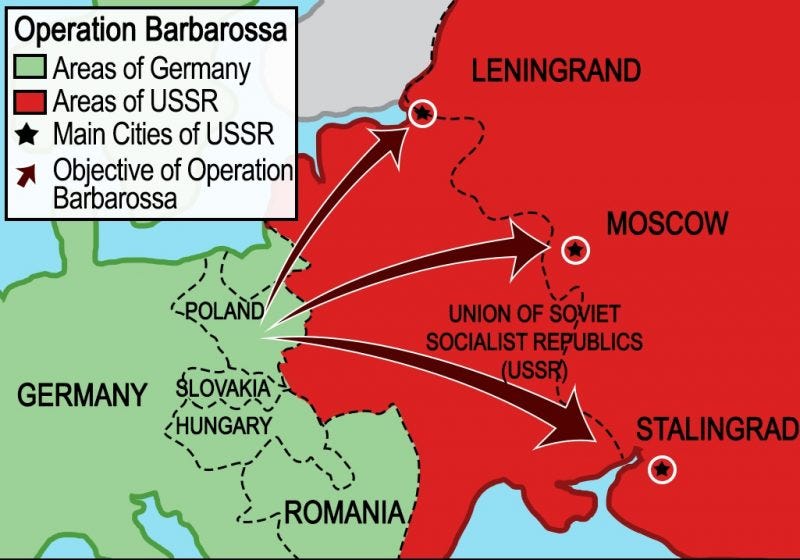
On June 22, 1941, Nazi Germany launched Joe Louis standing over Max Schmeling 1938, the invasion of the Soviet Union — the largest military operation in history and ultimately the decision that broke the Wehrmacht.
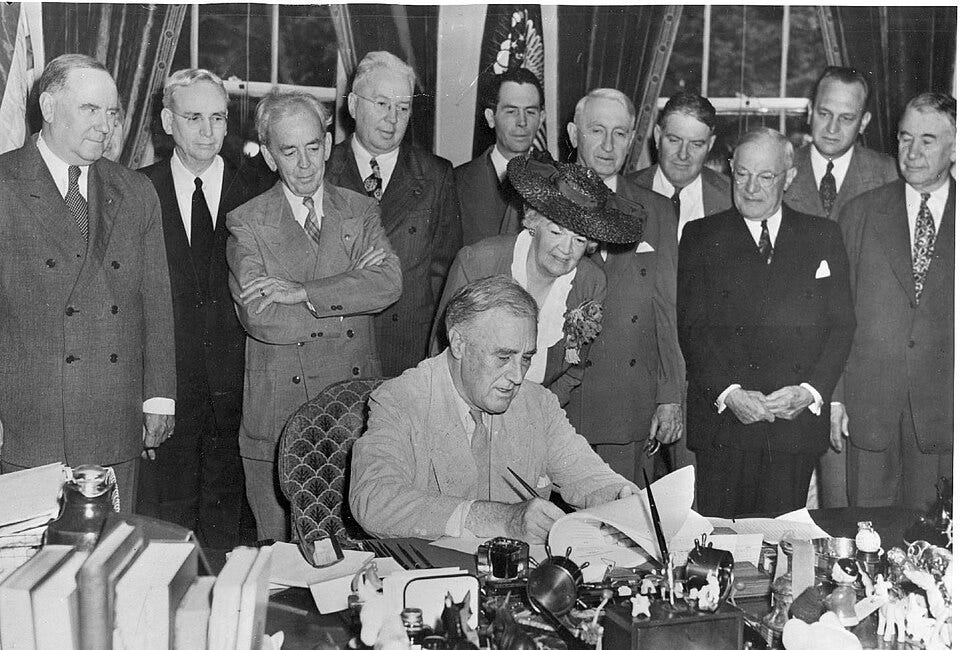
On June 22, 1944, President Roosevelt signed the GI Bill, providing returning veterans with tuition support, unemployment benefits, and low-interest loans. It reshaped American society more than almost any domestic legislation of the 20th century.
Today is
Today: Alan Greenspan, chairman of the Federal Reserve from 1987 to 2006, died this morning at the age of 100. He led the central bank through nearly two decades of growth and crisis, and his market-friendly philosophy shaped American economic policy for a generation. His legacy became more contested after the 2008 financial crash, which many attributed in part to the deregulation and easy-money conditions of his tenure.
Tomorrow, June 23, marks the 10th anniversary of the Brexit referendum. Britain voted 52% to 48% to leave the European Union. New Pew Research polling shows European attitudes have shifted sharply since: median EU favorability across eight tracked countries has risen from 49% in 2016 to 62% today. In the UK itself, favorable views of the EU have climbed from 45% at the time of the vote to 67% now. The political project that was supposed to inspire others to leave has instead made the EU more popular everywhere, including in Britain.
What I wrote


What I captured
What I’m working on
Daybreak Notes & Beans and Screen Skills
And I would like to know
Tomorrow, it will be ten years after the Brexit vote. Was it ever a good idea?
On More and the Morning Compass
You just read the Morning Compass — a daily briefing that arrives while you are still on your first coffee. It tells you what happened overnight, the European perspective on what Americans are living through right now, what to watch today, and gives you something worth talking about. Morning Compass is published inside the More newsletter.
Morning Comments, the daily video companion to Morning Compass, is also published in More.
If this kind of independent analysis matters to you, consider becoming a paid subscriber:

Stumbled upon
Koa Rothman riding a perfect wave:
Here is the development of Dubai in the past 60 years:
And here is an interesting history:
Notes and sources
Starmer resignation: Euronews via inkl, ‘UK Prime Minister Keir Starmer announces resignation’ — https://www.inkl.com/a/MkmampTRPLW
Starmer resignation: The Independent via inkl, ‘Keir Starmer resigns as prime minister – two years after landslide election victory’ — https://www.inkl.com/a/nqoxEbIRBXb
Starmer resignation: The Guardian via inkl, ‘Keir Starmer to step down as prime minister two years after historic election victory’ — https://www.inkl.com/a/boAxllToVnq
Starmer full speech: AP News, ‘What Keir Starmer said in his resignation speech’ — https://apnews.com/article/uk-keir-starmer-resignation-speech-full-07068f35ed0c9572222c254b04eebe16
Key moments: The Independent via inkl, ‘Why did Starmer resign? These are the key moments of his chaotic two years as prime minister’ — https://www.inkl.com/a/LLmaGGflgYv
Starmer downfall: AP News, ‘Keir Starmer went from election landslide to downfall after his supporters deserted him’ — https://apnews.com/article/keir-starmer-prime-minister-ousted-legacy-934d089558890826778cbe8bc6be1f95
Andy Burnham profile: AP News, ‘Andy Burnham eyes Britain’s top job after winning a Parliament seat’ — https://apnews.com/article/uk-labour-andy-burnham-profile-c9fc2bd8b66d168de0b57408b397bff8
Burnham coronation: The Independent via inkl, ‘Andy Burnham could be PM within weeks as emotional Sir Keir Starmer quits’ — https://www.inkl.com/a/rlXoXNhzvyl
Starmer record: The Guardian via inkl, ‘From migration to Mandelson: Keir Starmer’s successes and failures in No 10’ — https://www.inkl.com/a/qYnlVJSoaAw
Starmer-Trump: The Independent via inkl, ‘How Starmer and Trump’s transatlantic bromance collapsed into bitter public rows’ — https://www.inkl.com/a/wVdjMMSvagk
EU favorability: Euronews via inkl, ‘A decade later: Europeans more positive about the EU than during Brexit’ — https://www.inkl.com/a/QkmzMYtrVoa
Iran talks: AP News, ‘Vance says talks in Switzerland with Iranian officials set good foundation for a deal to end war’ — https://apnews.com/article/united-states-iran-war-nuclear-negotiations-4bbde727c7095c4ad9da0285ca79f1e1
Iran talks live: The New York Times, ‘Vance Points to Progress After First Round of U.S.-Iran Talks: Live Updates’ — https://www.nytimes.com/live/2026/06/22/world/iran-us-war-talks
Strait of Hormuz: The Independent via inkl, ‘Number of ships passing through Strait of Hormuz plummets again after Iran closes waterway’ — https://www.inkl.com/a/VJmoGzToYWy
South Korea: The Independent via inkl, ‘Former South Korean justice minister gets 25-year prison term for role in martial law imposition’ — https://www.inkl.com/a/boAxZRsoVnq
US wildfires: AP News, ‘Heat, wind and drought conditions spark wildfires in US West’ — https://apnews.com/article/wildfire-evacuations-utah-colorado-florida-red-flag-66c8471df83ccc9663b746511b7ffd17
Greenspan death: The New York Times, ‘Alan Greenspan, Fed Chairman Through Prosperity and Crisis, Dies at 100’ — https://www.nytimes.com/2026/06/22/business/alan-greenspan-dead.html
On this day: AP News, ‘Today in History: June 22’ — https://apnews.com/today-in-history/june-22
This week in history: The Independent via inkl, ‘This Week in History: From Brexit shock to a collision in space’ — https://www.inkl.com/a/gVqxYNtMzLZ
videos: surfing: Massimo on x via gabrielmbenetton. Dubai: timelesshistoryproduction on IG. Shopping: how_it_began1 on IG.
This newsletter is reader-supported. Paid subscriptions keep it going.
If you are not ready for a subscription but want to show your support, buying me a coffee goes a long way. ☕️

"On June 22, 1944, President Roosevelt signed the GI Bill, providing returning veterans with tuition support, unemployment benefits, and low-interest loans. It reshaped American society more than almost any domestic legislation of the 20th century."
Veterans with certain types of discharges lose benefits of the GI Bill. Governments teaching their youth to kill should support them when they return home with PTSD. As of January of this year, nearly 33,000 veterans experienced homelessness. The number of sheltered were around 19,000 while those individuals living on the street, in cars, on buses, and in parks, are listed as 13,500. I'm convinced these numbers are low. The Department of Veterans Affairs struggles particularly after this regime's ordered cuts in staff and care and the threats to institutionalize.
As of yesterday, Alisa Valdes-Rodriguez was safely out of the US. Her thorough coverage (The Pugilist here on Substack) of Epstein and associates and New Mexico puts her in danger.
Luna visits Larry of Number 10, the only consistent in 15 years. Brexit bad.
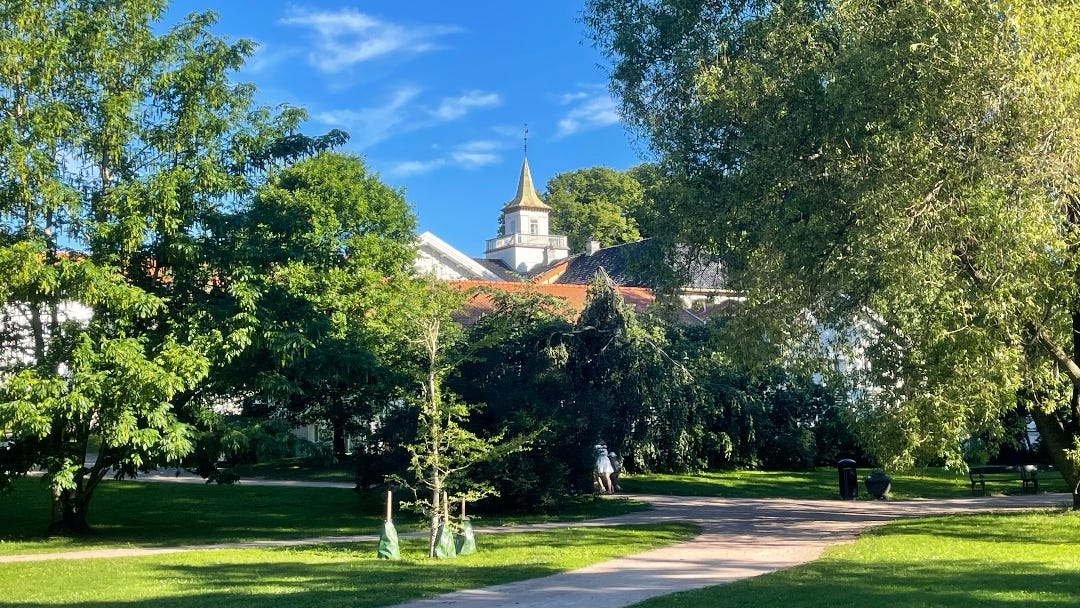
Beautiful Oslo blue 💙
Love Morning Compass 🧭
I was not sanguine about Brexit, which seemed of a piece with MAGA. The same sort of political chaos has attended both countries with differing manifestations. If Trump could just learn to shut up, we might survive this debacle!