

Introducing More, The Stories That Continue
Plus: Young penguins meeting a cat, the real man behind Popeye, Jesse Welles as the new Dylan, my wooden shoes, Ramses Shaffy's song for freedom, and why Hotel California keeps ending up in court


I promised myself not to start another newsletter. But here’s the problem: stories don’t stop when I hit publish.
A reader leaves a comment on The Planet that deserves more than a quick reply; it deserves a real conversation. A news item in Daybreak Notes & Beans gets a fascinating update two weeks later, but by then, we’ve moved on to other stories. I discover something useful about a Screen Skills topic, but it doesn’t fit the tutorial format. I have a follow-up on a travel story that I posted on Patreon, but it doesn’t fit with the latest article I published there. And then there are travel photos and archival pieces that don’t belong anywhere but still matter.
Good material constantly gets left behind. I find connections between topics that only make sense after I’ve already published. Updates don’t always fit the concept. The More newsletter is where those pieces land because there is always more to publish.
Think of this as my notebook; follow-ups to stories you’ve read, deeper dives when I didn’t have enough space, comments that sparked longer thoughts, archival pieces that suddenly matter again, and personal moments that don’t fit anywhere else. Sometimes Luna makes appearances. I’ll post when there’s something worth your time.
A Word About Supporting More
If you’re considering paid support, please first subscribe to at least one of my main newsletters: The Planet, Daybreak Notes & Beans, or Screen Skills. Those are the core publications with established formats and reliable schedules.
More is different. It’s experimental. It’s a digital scrapbook where I share what doesn’t fit elsewhere. I can’t promise consistent frequency or format because I’m still figuring out what this wants to be. Some posts might be substantial deep dives, others might just be a photo and a paragraph.
If you’re willing to support this experiment, you’re essentially backing the creative process itself rather than a finished product. Fair warning: if More doesn’t develop into something sustainable, I’ll refund paid subscribers proportionally for the remaining time on their subscriptions.
This isn’t a lack of confidence; it’s honesty about creative work. The best newsletters I’ve built started messy and found their rhythm through reader feedback and experimentation. More is in that messy early stage right now, and I love experiencing this again.
Support if you’re curious to watch that process unfold.
Some posts will eventually be for supporters only, but for now, everything’s free. As I did with previous newsletters I launched, I need time to find the right formula, and I’d love your input on what works.
Supporting More means supporting the whole ecosystem of my work; not just this newsletter, but the creative space where I answer your questions, follow up on developing stories, and explore ideas that eventually feed into The Planet, Daybreak Notes & Beans, and Screen Skills. If you value having access to that process, consider becoming a paid subscriber:
On those young penguins meeting a cat for the first time
I posted a video on Notes a few hours ago showing a group of young penguins chasing a cat, and the questions started immediately: “What is a cat doing in a penguin colony?”
Fair question. Here’s the answer:
Those aren’t adult penguins—they’re king penguin chicks from the Falkland Islands. The brown, fluffy down feathers are typical for young king penguins, who stay this color for 14-16 months before they develop the classic black-and-white adult plumage. They’re already quite large, which is why they look oddly proportioned—big bodies, baby feathers.
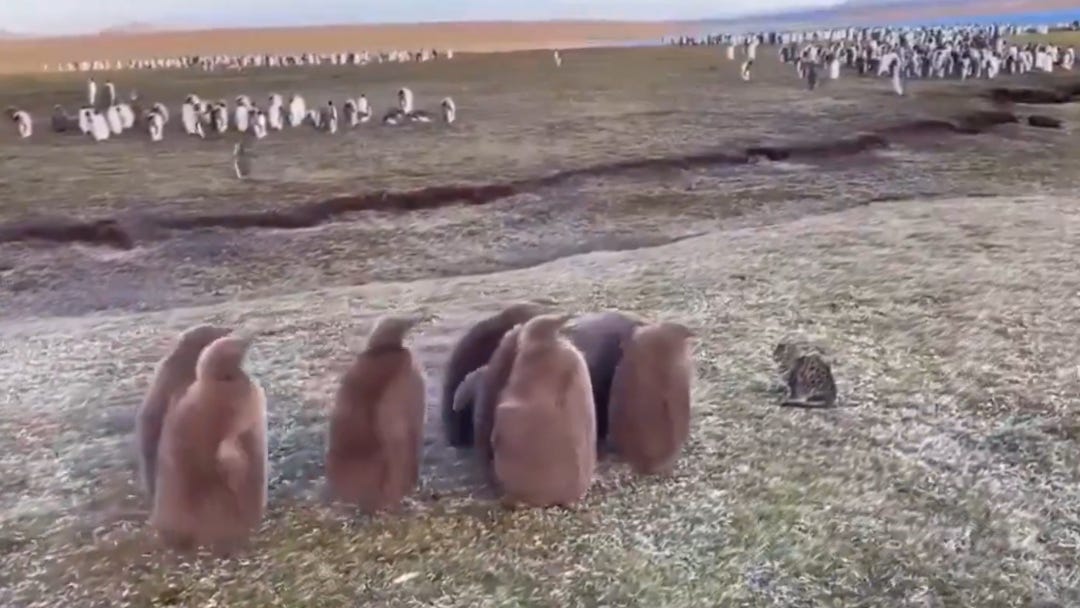
The Falkland Islands sit off the coast of Argentina in the sub-Antarctic region. It’s a British Overseas Territory with major penguin colonies and, yes, feral cats roaming around. So cats and penguins actually share habitat there.
The chicks are displaying natural curiosity toward something they’ve never seen before. The cat, wisely, keeps walking away from this gang of large, fluffy juveniles who clearly haven’t learned to fear much yet.
And to answer the broader question: penguins don’t only live in Antarctica. You’ll find them along the coast of South Africa (African penguins), in Australia and New Zealand (little penguins), throughout Chile and Argentina (Magellanic penguins), and in various sub-Antarctic islands like the Falklands. Wherever there are penguins in these warmer regions, there can be cats too.
Sometimes those encounters lead to problems—feral cats threaten eggs and chicks in places like the Galapagos. But sometimes they just lead to curious chicks following a bewildered cat across the colony, creating the kind of viral video that makes people smile all over the world.
Dutch Children: Still the Happiest in the World
I’ve been posting quite a few cartoons recently on Notes—Wile E. Coyote and the Road Runner, Tom and Jerry, Popeye, classic animations that make people smile. In the spirit of Daybreak Notes and Beans, I try to share happiness there, and cartoons fit perfectly into that. What surprised me was how many readers started sharing memories of their youth watching these cartoons. Some of you are still watching them, and I can’t blame you. I still love them too.
The comments turned into fascinating discussions about childhood, television time, and how we spent our days differently. Many readers remembered having almost no youth programming on TV, so we played outside instead, rode our bikes everywhere, and visited friends without parental supervision. That independence shaped us.
Which brings me to the latest UNICEF report: the Netherlands ranks number one again for child well-being and life satisfaction in UNICEF’s 2025 “Report Card 19.” Among 43 EU and OECD countries studied, Dutch children report the highest life satisfaction. This continues a pattern stretching back to at least 2007—nearly every UNICEF study since then has confirmed that Dutch children are among the happiest in the world.
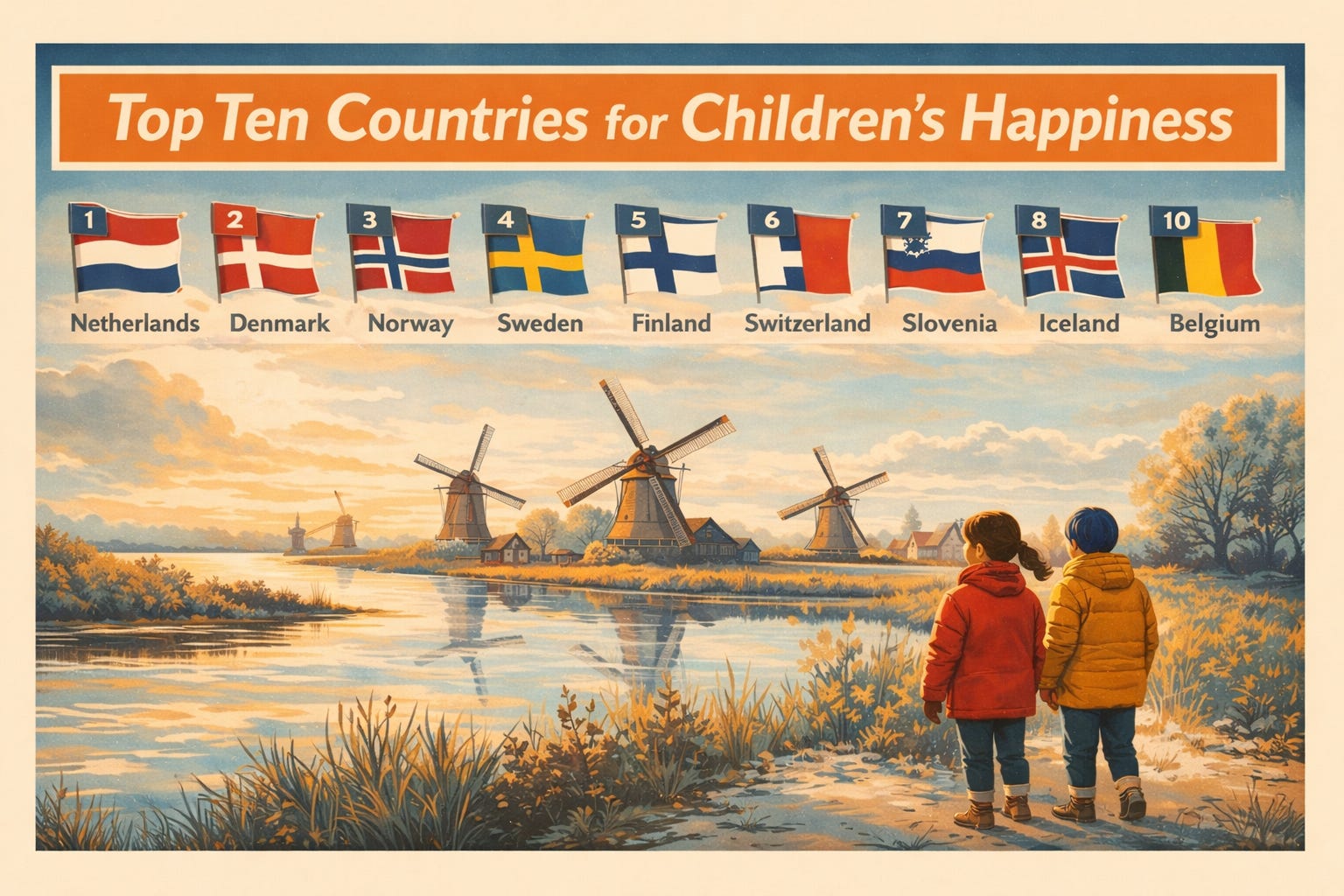
The researchers point to several factors, but one stands out: Dutch children still play outside. We have our bicycles from an early age. We have the independence to roam our neighborhoods, visit friends, and make our own adventures. The combination of outdoor play, physical freedom, and social connection creates something special.
The contrast with other wealthy nations is striking. The United States ranks 37th out of 43 countries—near the bottom, just ahead of Mexico, Turkey, and Chile. American children score poorly across all three dimensions the report measures: mental well-being, physical health, and educational skills. The gap between Dutch and American childhood experiences couldn’t be clearer in the data.
When I read those cartoon discussions on Notes alongside this UNICEF data, the connection became obvious. That generation of readers who grew up with limited TV and lots of outdoor time was practicing what Dutch parents still do today. Happiness isn’t about screens and structured activities; it’s about letting kids be kids—outside, on bikes, with friends, making their own fun.
Here is an example of the bottle game: be the first to collect three bottles. Do you remember playing it?
The Real Popeye
Speaking of those cartoons: years ago, when I was still very active on Twitter, I posted a photo of the real Popeye. Not many people know this, but the cartoon character was based on an actual person.
His name was Frank “Rocky” Fiegel, a Polish immigrant who lived in the town of Chester, Illinois—the same town where Popeye creator Elzie Segar grew up. Fiegel was a local character known for his extraordinary strength, his prominent chin, and yes, his corncob pipe. He worked odd jobs around the docks and had a reputation for getting into fights and always winning them. He was also known for his kind heart despite his rough exterior.
When you see photos of Frank Fiegel, the resemblance to the cartoon is remarkable. The jutting chin, the muscular build, the squinting eye—Segar clearly drew from life. Fiegel even had a love interest named Dora Paskel, who, according to local legend, inspired Olive Oyl.
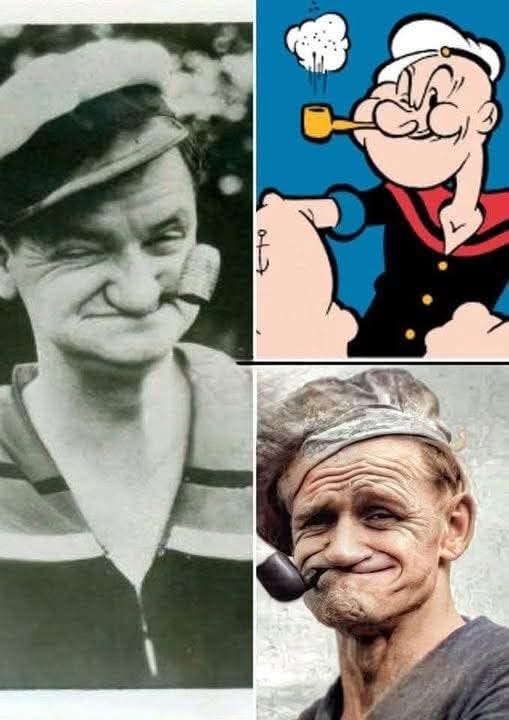
Fiegel died in 1947 and is buried in Chester. The town has embraced its Popeye connection—there’s even a Popeye museum and a statue of the character. But the real man behind the cartoon lived a much harder life than his animated counterpart, working manual labor jobs until his death at 84.
I love discovering these connections between fiction and reality. The cartoons we watched as kids often had deeper roots in real communities and real people than we ever knew.
My Dutch Credentials
A reader asked about the wooden shoes I mentioned banging against the lamppost to knock off the ice, and that a German tourist wanted to photograph. Here they are, my klompen in Dutch snow.

These aren’t museum pieces. I wear them when it’s muddy because they work.
Why I Put SPAM Cans in a Screen Skills Article
A reader asked about the photo in my January 7th Screen Skills newsletter showing rows of SPAM cans stacked neatly together. What does canned meat have to do with junk email?
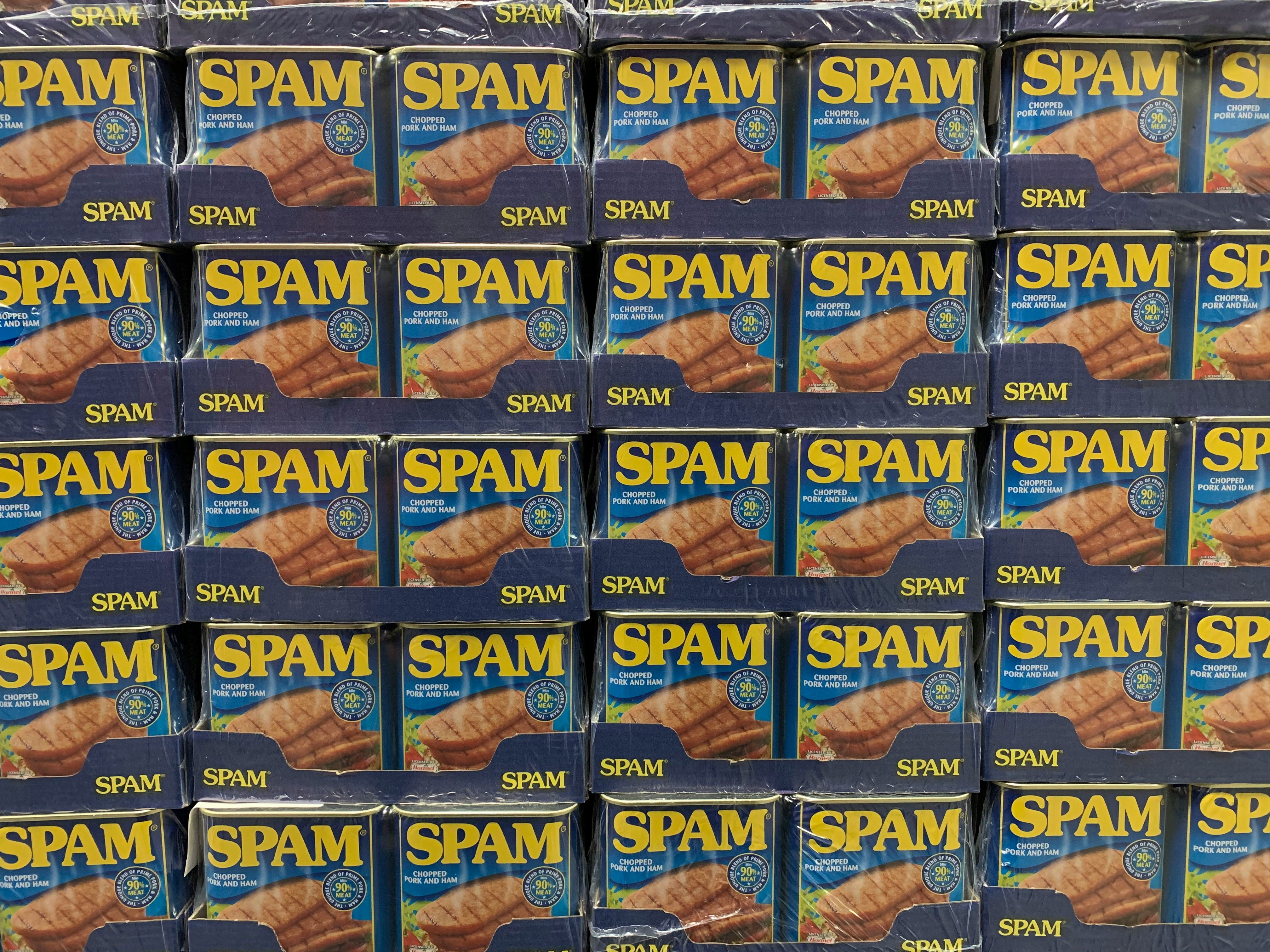
The connection is Monty Python.
In a 1970 Monty Python sketch, a café serves only dishes containing SPAM—the Hormel canned meat product introduced in 1937. The waitress lists menu items: “Spam, spam, spam, spam, baked beans, spam, spam, spam...” Meanwhile, Vikings in the background chant “SPAM, SPAM, SPAM” louder and louder, drowning out all normal conversation.
When early internet users in the 1980s encountered repetitive, unwanted messages flooding their forums and inboxes, someone remembered that sketch. The messages were like the Monty Python SPAM—overwhelming, repetitive, drowning out everything useful.
The term stuck. By the 1990s, “spam” meant junk email.
The SPAM company (Hormel Foods) didn’t do the spamming—their product just became internet culture’s metaphor for digital annoyance, thanks to British comedy. They weren’t thrilled about it initially, but they’ve since embraced the connection.
Hear the song of a cowbird
You may remember that, on Thursday, I wrote in Daybreak Notes & Beans that scientists discovered how cowbirds produce their remarkable bubbling song that sounds exactly like water droplets splashing into a pond. Ann asked to hear that sound. Here it is, in my shortest video ever: just seven seconds.
Jesse Welles: The New Dylan?
Several of you have mentioned Jesse Welles in comments recently; I thought it was time to spotlight him properly.
Welles is being called “the new Dylan” by some—a folk protest singer for our current moment. His song “War Isn’t Murder” went viral, and more recently, “JOIN ICE” has been making waves. The lyrics cut deep, addressing the psychology behind authoritarianism with the kind of sardonic edge that protest music needs.
Jay Jay quoted these lines: “I got picked on at school, I never felt that cool / There’s a hole in my soul that just a-rages / All the ladies turned me down, and I felt like a clown / But will you look at me now, I’m puttin’ folks in cages.”
That “hole in my soul that just a-rages” line captures something essential about the current political moment. Welles understands that authoritarian impulses often come from deep personal insecurity, and he’s not afraid to say it plainly.
I grew up during a period when music was enormously important to youth in shaping opinions about society. Folk music, rock, punk—they were all criticizing, protesting, offering hope and inspiration for a better world. During my years working full-time on climate change issues, I always wondered why there weren’t more popular bands focusing on environmental collapse. And now, with democracy deteriorating in so many countries, you’d expect more artistic opposition.
There are exceptions, of course. Bruce Springsteen’s recent live EP takes on Trump directly. Various hip-hop artists. But generally, popular music seems less politically engaged than in earlier generations. Which makes Jesse Welles all the more important. He’s filling a space that’s been too empty for too long.
Watch “JOIN ICE” on YouTube. It’s protest music with wit and anger in equal measure.
Ramses Shaffy and the Prayer for Freedom
When I posted a video on Notes with Ramses Shaffy singing in the background, Michel wrote one of the most beautiful comments I’ve received. Let me quote it in full:
“An intensely beautiful song from Ramses Shaffy about the request for freedom to be his own unique Self. To be allowed to express himself in the way that belongs to him as he is. A prayer to allow authenticity. A prayer that surpasses time as it belongs to every living being. It touches the Soul of the honest ones who are not afraid to be vulnerable, but are rather afraid to live an unfulfilled life that is not theirs.
“No judgement, no critical condemning, but simple, pure. Why should we not tolerate each other in their expression of who they feel they are? Everything can coexist. Only the mind creates separation and duality and tries to force others in a culturally or religiously defined box of limited thoughts.
“A society can only thrive in love and happiness if we unconditionally respect and accept each other as they are. There is no ‘normal’. There’s only uniqueness that prays for freedom to be accepted as it is.”
Ramses Shaffy is unknown outside Dutch-speaking areas. He only sang in Dutch, which limits his international reach. But in the Netherlands and Flanders, he’s a cultural icon—part troubadour, part hippie, a fixture of the Amsterdam scene who sang about love, freedom, and authenticity with raw emotion.
The song Michel references, “Laat me, laat me” (Let me, let me), is Shaffy’s plea to be allowed to be himself. The lyrics are simple but devastating in their directness. It’s the kind of song where the words matter as much as the music, which makes me wonder whether non-Dutch speakers could appreciate it the same way.
Watch Ramses Shaffy here, in a 1978 recording in unmistakable fashion and colors of that era.
I don’t speak Italian, but I love Italian opera. The music carries me even without understanding every word. But I wonder where Shaffy fits in for those who don’t speak Dutch. Is he closer to the instant beauty of a Puccini opera, or is he closer to a singer like Bob Dylan? Are there people who don’t speak English and listen to Dylan? I’m not sure I would. The poetry is inseparable from the music, and Shaffy’s voice is so much more beautiful than Dylan’s.
So I wonder if Shaffy’s emotional authenticity transcends language barriers. His vulnerability comes through in his voice, in the way he holds notes, and perhaps non-Dutch speakers feel the passion behind each phrase. You might not know the words, but you’d feel what he’s feeling. (There is more at the end of this newsletter, in the ‘Still here?’ section).
More gives you what the other newsletters can’t: the rest of the story, answers to your questions, the additional context, updates on developing stories, the connections between topics, and the personal moments that don’t fit polished formats. If that extra layer matters to you, consider supporting this work:
Hotel California’s Legal Maze
A few days ago, I wrote for Daybreak Notes and Beans about album covers and the Grammy Awards. As an example, I mentioned the cover of Hotel California—partly because it’s iconic, but mainly because it was the very first album I owned.
I got a small record player for my 12th birthday; white and bright orange plastic, a wonderful, subtle combination of colors that was very mid-1970s and that the world has since then wisely abandoned. My parents gave me the Hotel California album to go with it. That summer of 1977, the song was everywhere.
I remember staring at that cover for hours. The mysterious hotel at dusk, the palm trees, the slightly eerie glow. As I often wrote before, when I grew up, America was this mythical land where everything was better. I remember how much I envied a friend who had actually been there; it sounded like meeting an astronaut who had walked on the moon. California was probably the first US state I learned about once I realized the United States was a collection of 50 states, because that’s where the movies were made. And quite a bit of music. So just staring at that album cover gave me a kind of connection to this mythical place.
When I wanted to include an image of that album cover in the newsletter, I couldn’t find a copyright-free version. While searching, I stumbled into a legal mess I never knew existed. Turns out everyone has been suing everyone over Hotel California.
The hotel on the cover is the Beverly Hills Hotel in Los Angeles, not the Hotel California in Todos Santos, Baja California Sur. The front cover photograph shows the Beverly Hills Hotel on Sunset Boulevard, shot from a cherry picker at dusk to give it that cinematic, slightly eerie feel. When the identity became widely known, the Beverly Hills Hotel reportedly threatened legal action over the use of its image.
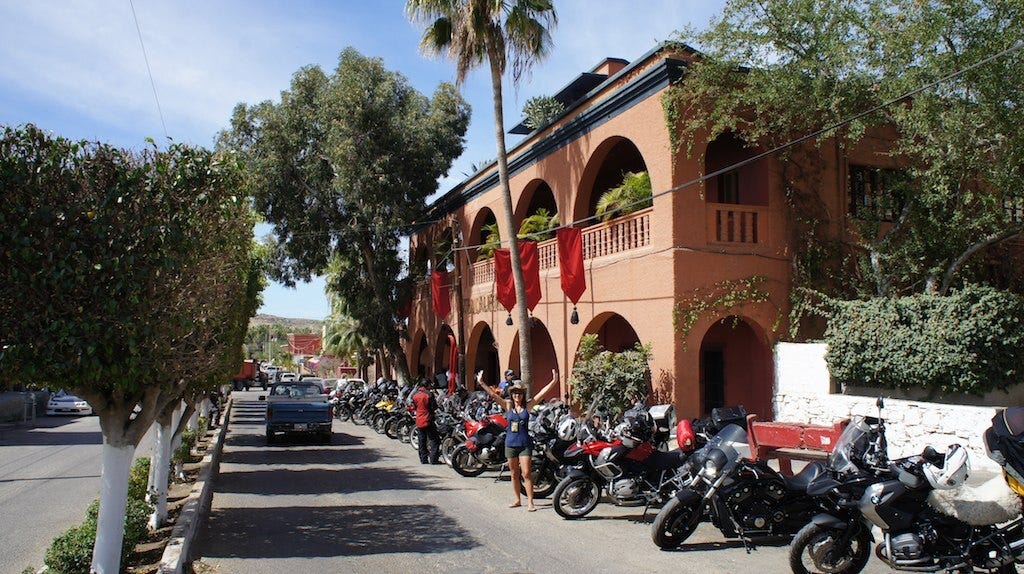
But there’s also a real Hotel California in Todos Santos that predates the song and has spent decades trading on the perceived connection. Many visitors assume it inspired the track. The Eagles have repeatedly said the song isn’t about that hotel. The band actually sued the owners over marketing that suggested an official link. The case eventually settled, and the hotel now states there’s no connection, though they still benefit enormously from confused tourists.
So you have the Beverly Hills Hotel upset about appearing on the cover without permission. You have a Mexican hotel sued for pretending to be the inspiration. And somewhere in all this, The Eagles are just trying to protect their intellectual property while millions of people create their own myths about what the song really means.
A 25-Year Friendship
Lillian sent me a message: “Happy New Year: sending a very heartwarming story from YouTube—A 25-year friendship between an Owl & a man.”
The video shows a man who found an injured owl, cared for it, and the owl never left. For 25 years, this owl has stayed with him. It is a friendship that defies everything we think we know about wild animals and human relationships.
It’s the kind of story that reminds you why I started Daybreak Notes & Beans as a good-news newsletter, and why I started to share happiness on Notes. We need positivity and hope in a time of disastrous politics. If you prefer a story about an owl who chose to stay, instead of ICE raids and oil grabs, watch it here:
What Happens Next
This is still an experiment. I’m building More the same way I built my other newsletters—by listening to what resonates and letting the concept develop naturally.
Paid subscriptions are available now, but I want to be transparent: I expect most More supporters will already support one of my other newsletters. This isn’t the core product—it’s something extra for people who already receive the main newsletters and genuinely want more. Hence the title.
Your support makes this experimentation possible, and I don’t take that lightly. If More doesn’t develop into something sustainable, I’ll refund paid subscribers proportionally for the remaining time on their subscriptions.
If you have thoughts on what’s working or what you’d like to see, tell me. This space belongs to the community as much as it belongs to me.
Stay inspired,
Alexander
Still here? More has more to share:
Remember yesterday’s story in Daybreak Notes & Beans about the “Nijntje”, Miffy snowman, where two police officers restored the vandalized snowman’s (snowrabbit’s) ears? Here is the grainy video recording. It didn’t make international headlines, but nationally it made it to the “children’s news” of the NOS. Here is the story in 26 seconds:
English translation of the Ramses Shaffy song
You may be interested in a translation of Ramses Shaffy’s song. Here is a version that is not ‘singable’ but true to the original meaning. It’s a passionate appeal to the world to accept him as he is, with the freedom to live and be whoever he wants. It is a powerful song that ultimately became a symbol of Shaffy’s authentic, free-spirited nature.
I may have been born too late
Or in a land with different light
I always feel a little lost
Even when the mirror shows my face
I know the bars, the cathedrals
From Amsterdam down to Maastricht
Still every day I’ll lose my way
That’s what keeps things in balance
Let me
Let me
Let me go my own way
Let me
Let me
I’ve always done it this way
I won’t forget my friends
Those I love, I’ll always love
And I should know where they live
But I lost their last letter
I’m sure I’ll meet them again
Maybe today, maybe in a year
I’ll kiss them, greet them
It’ll all work out again on its own
Let me
Let me
Let me go my own way
Let me
Let me
I’ve always done it this way
Luckily, I’m not anchored
Sometimes I live here, sometimes there
I haven’t ruined my life
I have no possessions and no objections
I love water and I love earth
I love the humble and the grand
There’s not a penny that I saved
I simply live from hour to hour
Let me
Let me
Let me go my own way
Let me
Let me
I’ve always done it this way
One day I’ll die as well
There’s really no escaping that
So let my songs wander freely
And the rest is up to you
For now I’ll keep on kissing you
Your black sheep, your loyal fan
I’ll stay a long time—preferably longer
And let me remain who I am
Let me, etc.
Notes:
video bottle game via itsme_urstruly
"Meanwhile, Vikings in the background chant “SPAM, SPAM, SPAM” louder and louder, drowning out all normal conversation."
😂 Loving More already!
I enjoyed every word of More. With its followups to previous stories, it reminded me of the late Paul Harvey, American radio broadcaster, who had a show called “The Rest of the Story.”